Instant phone access when you land – avoiding high roaming and call charges.
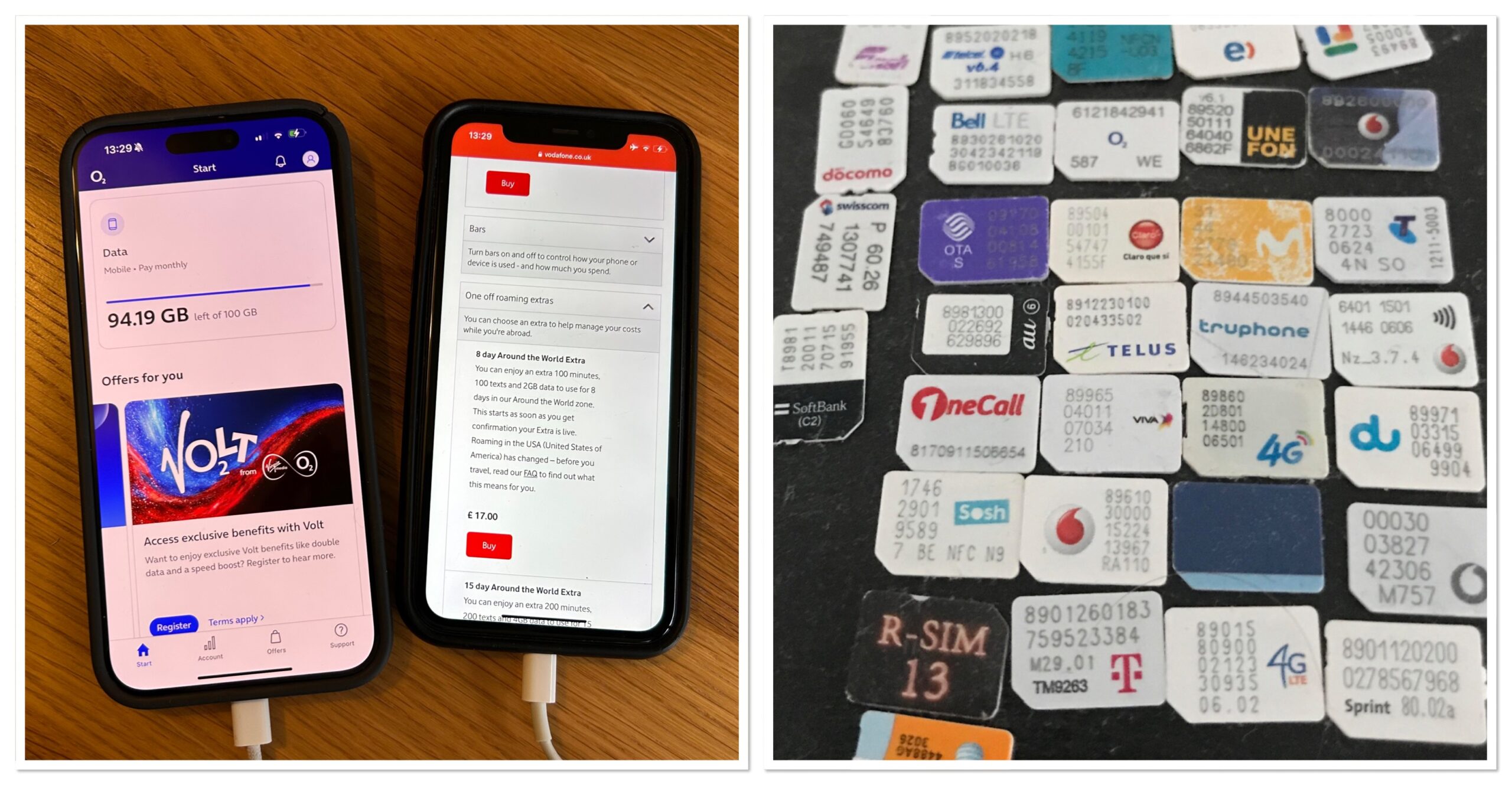
I used to buy a local SIM at the destination airport before leaving the baggage hall, or airport proper. This is often the cheapest way of avoid high data roaming charges.
However, it’s often not the most convenient (long queues and competing, confusing services) and also meant that I ended up with a different telephone number every time I travelled to a different country, which can be confusing to people back home. It also means I was starting to collect SIMs!
ALSO: Buying a local SIM also means I’d be on a local telephone network, so calling back home (other than via a web based app) costs a small fortune! E-SIMS, the obvious alternative, have similar issues and are primarily designed for data.
So, after a few years of trial and error, I have now rounded on the following preferred options.
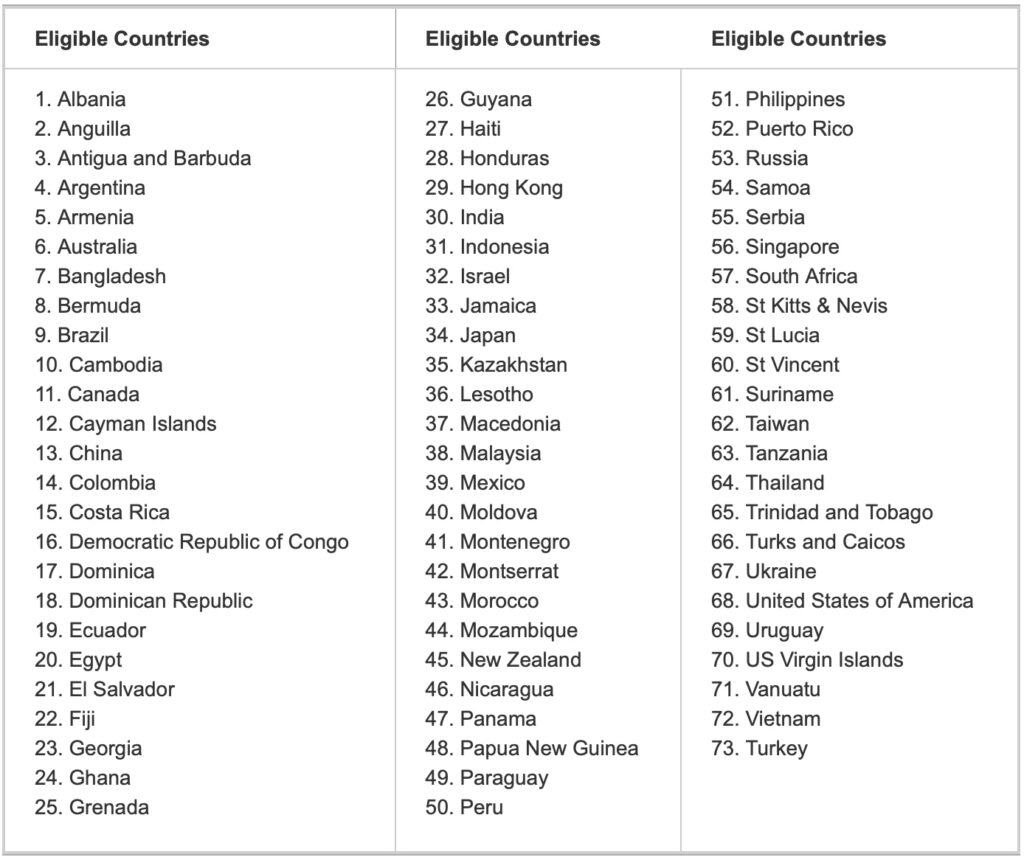
O2 – ULTIMATE TRAVEL TARIFF (My preferred method which covers 123 counties for a standard monthly tariff)
I mentioned in my blog to Albania (May 2026) that I’d been watching episodes of The Handmaid’s Tale on the flight, having downloaded it from Disney Plus. The reason I mention it again here is because I managed to get Disney Plus (ad-free) thrown in gratis as part of an O2 upgrade we took out a week earlier.
Coming to Albania, I’d originally planned to buy a virtual eSIM through Airalo, as I usually do. However, after a bit of digging, I discovered O2 had a very good deal on, so I upgraded my international roaming package to include Zone 2 and an additional 75 countries on top of the standard European coverage already included.
I now have access across 123 countries in total, including Albania, the USA, Canada, Australia, New Zealand, Malaysia, the UAE, India and many others.
The upgrade only cost an extra £8 per month. That means I can keep, and actually use my UK number while travelling to these new destinations. Given that ad-free Disney Plus alone costs £9.99 per month, and they also include multi-device McAfee Security (worth around another £5 monthly), it felt like excellent value.
More importantly, it means I can make and receive proper telephone calls on the move, send and receive texts, and keep access to my 200GB data allowance outside Europe, something a virtual eSIM generally can’t match. Most eSIM packages also offer far less data.
Given how much we travel, it was a bit of a no-brainer really. The only downside is that download speeds are capped, but in practice I’ve barely noticed. Streaming, maps and general browsing have all worked perfectly well.
The McAfee security package is useful to have while travelling too, although I already subscribe to NordVPN, so for me the Disney Plus perk was probably the bigger win.
I mention it here because, if you travel outside Europe regularly, it’s definitely worth considering. For me, having an additional 75 non-European countries covered is far more convenient, and ultimately more cost-effective than constantly faffing about with separate eSIMs. From a user perspective, it’s also vastly simpler.
It’s easy enough to find online, but I’ve included a screenshot from the O2 website (of the additional countries covered, over and above Europe) below for reference.

Option 2 – eSIM (Airalo)
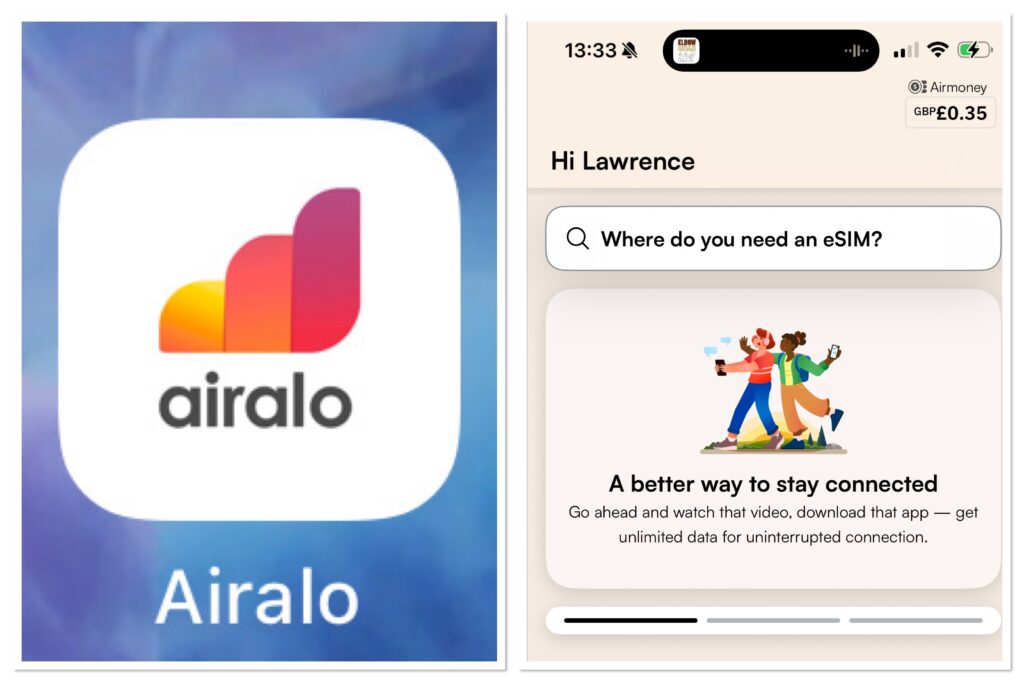
I tried out an eSIM for the first time when in Turkey (and before the O2 upgrade above) and despite not having a local telephone number allocated to the SIM, (like my Vodafone option) it worked great and covered most of my needs.
I simply downloaded the App, selected the country, paid about a fiver (5gb for a month) and got instant access to the 4g and 5g network as soon as my plane landed.
I must admit that I prefer having an allocated local number via the Vodafone route I mentioned earlier BUT I’ve noticed over the years that most businesses now recognise that travellers have an eSIM without an allocated local number and so publish their WhatsApp number and communicate via websites.
So to this would be my recommendation for flexibility, instant access and price.
However, I think I will always take the spare phone “just in case” but will use the eSIM on my regular phone going forward.
Option 3 – Vodafone Worldwide SIM
So a while ago, before O2 deal came along. This option worked for me and was a great way of utilising a second (back up) phone.
I purchased a “pay-as-you-go” Vodafone SIM permanently installed in it on a second phone.
Then I bought an “Around-The-World-Extra” for the period I am travelled, and hop straight onto it when I land. They are for sale for 8 and 15 days.
It means I could keep the same UK based Vodafone number when travelling (although this permanent number differs from my main one). The result is that my family and friends back home can get hold of me in an emergency via the telephone network and don’t have to wait till I’m on WiFi. I can make UK and “in country” calls without incurring high charges.
At the time I took this out O2 were less competitive. So it worked for me at the time, and should I visit a country that is NOT covered by the O2 contract (one of 123 countries), I may well consider this and compare costs to the Airalo method above.
Its NOT the cheapest way of doing it, but does mean that I get 100-200 minutes of phone use (to the UK and all LOCAL country numbers), together with a large number of texts and somewhere between 2GB and 4GB of data dependent on plan (8 day or 15 day).
The cost of this is quite high, £17 and £27 respectively, BUT it does mean I can use the phone as soon as the aircraft touches down. Vodafone do a “European” equivalent, for about 1/3 cheaper (and more data).
Younger travellers (Gen Z and Millennials) might find 2GB-4GB of data far too small to live with, but so far, I have never run out of data. I simply hop on and off WiFi networks in coffee shops, hotels and elsewhere. I simply use the Mobile data on the “Around-The-World-Extra” for all sensitive transactions (such as bank transfers and sensitive emails). This reduces the chance of running into trouble on an insecure WiFi.
The other advantage is that by having two phones with me, if one were to go “walkabout”, I can use the other for disabling the lost/stolen phone. I am an Apple user, so the “find my” feature means I can wipe the other phone off the map quickly.
This might sound like a bit of extravagance, but it helps with peace of mind, and the ‘trade-in’ for my Apple iPhone 11 was not a huge amount, so it was worth keeping hold of my old one for travelling purposes.
Before the iPhone, I used a cheap android for the same purpose (which I got for under £50), but found the features were less helpful.
This works for me, ensures than the split second I have landed I am able gain access to everything I need, and have a phone that works immediately.
Hope this helps.