
I’d never heard of the Holiday Property Bond before meeting Emma, and I’ll admit, I was a little suspicious at first. Over the years, I had grown wary of anything that sits outside the “normal” way of booking holidays. We’ve all heard of timeshare horror stories and the pyramid schemes of the 80s.
I’ve always preferred to sort things myself: research the destination, book the flights, choose the accommodation and deal direct.
Mistakenly, I had lumped HPB in with timeshares (and even package holidays), and had assumed Emma’s parents, who bought tens of thousands of bonds decades ago, had been talked into something questionable.
I could not have been more wrong. Here’s why.
HPB started in 1983 and now has properties in 33 locations across Europe, and not just any properties. Think stately homes, castles and beautifully restored villages in France, most come with swimming pools, saunas, gyms and tennis courts added thoughtfully. HPB offer everything from studios and one-bedroom apartments to large private villas with pools, and whilst it sounds like a timeshare, it’s isn’t, it’s a completely different model of ownership, more on this later.
We’ve only used properties up to two bedrooms so far. Our last trip to Turunç in Türkiye cost just over £150 per person for the week in a studio (points-free in July). Mallorca last year cost £136 each, and the one-bedroom apartment we booked for December in Vierhofen, Austria (near Zell am See), was £184 each. This room even came complete with its own private sauna.
Prices don’t change between low and high season, which is refreshing.
The kitchens are genuinely impressive too, like something curated by the Waitrose or M&S design team. Everything you could possibly need, plus quality appliances.
As a bond holder the concept is a little different from renting a facility from a random third party, as we are, in effect the third party. The result is that most bond holders treat facilities like they would do their own home, probably better! It’s simply in every bond holders interest to protect their investment.
We’ve managed several trips in 2025 and 2026 so far. Click here to see the individual blogs for these trips. At these prices, and with this level of quality, it’s easy to see the appeal and why the cynicism I had at the start has now been consigned to the distant past.
SO WHY ISN’T EVERYONE DOING THIS?
Two reasons stand out:
1. You have to buy bonds.
Becoming a bondholder feels unusual to most people. The minimum outlay is £5,000, and I think this is where most people stop and wonder about the upfront cost and the potential return on investment.
2. High-season bookings (made in advance) need more bond points.
To secure peak-summer properties in the most sought-after locations, you’re going to need a higher number of points than the minimum investment.
Now, most bondholders I speak to have in excess of 16,000 points (£16k), which not only allows them to pre-book many properties in sought-after locations, but also gives them the ability to book early for points-free holidays.
SO HERE IS THE HACK
We’ve found a simple, completely above-board way to enjoy multiple HPB holidays throughout the year at very low prices without needing to invest in a huge number of bonds. This approach will probably not work for families, or for those who are working and need to pre-book, but it works like a dream for people who are flexible or retired (like us).
THE APPROACH
Buy £5,000 of bonds (the minimum investment) or better still, £7,000 of bonds (for fully qualified membership), then save your points by booking most of your trips at the last minute:
- 21 days ahead for the UK (fully qualified bondholders have 28 days)
- 42 days ahead for Europe (fully qualified bondholders have 56 days)
Last-minute bookings don’t use points, so you get to keep your points (and even start to build them up) while still enjoying high-quality accommodation at incredibly low prices. Right now (I just checked), there are dozens of properties across the UK and Europe for between £275 and £500. Add some cheap flights with a low cost carrier, or drive and you’ve got yourself a bargain.
Honestly, grab your boots and go exploring – it’s what we’ve been doing – have a look here.
The other thing that’s really worth considering is that the bonds can not only be used by family and friends during your lifetime, but they can also be passed on to your children or partner as an inheritance. In other words, they never disappear and are incredibly flexible.
REQUEST A BROCHURE — GET A £20 VOUCHER
If you request a brochure using THIS introductory link, you’ll get a £20 John Lewis/M&S voucher automatically – no catch. We’ll get a gift too!
OR, if you don’t want/need the voucher, then just simply google ‘Holiday Property Bond’ and find the HPB home page and pick it up from there, it’s simple enough to find. I’d rather you explored this opportunity than think that the only reason I’m pushing it is because of a £20 financial reward – I’m not!
Indeed, the is something I don’t even personally benefit from – as the reward goes Emma, as she is the bond holder not me. But I thought I’d include it because it’s a win/win and I’ve genuinely loved the holidays we’ve had with them, so thought I’d share the information – and be transparent as it’s the only place on lawrencestravels.com that has a reward linked to it. But like I said earlier, if you don’t want to click the link, just google it and find out for yourself.
Go-on, don’t be a cynic like I was, it really is great value…
What’s the difference between HPB and a Timeshare
I am often asked this question so I’ve summarised the main differences here.
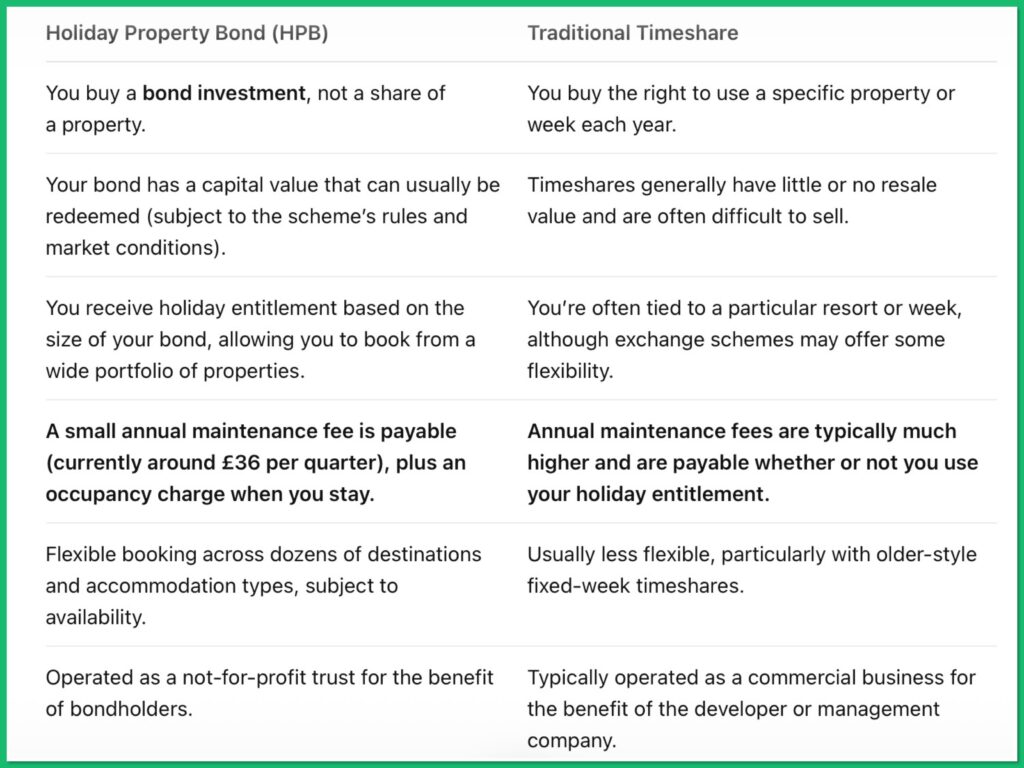
The biggest differences
1. It’s an investment, not a purchase of holiday time
With HPB, your money buys a bond. That bond gives you holiday entitlement each year, but it also retains a capital value. If you decide to leave, you can ask for your bond to be redeemed, although the amount you receive will depend on the scheme’s rules and the value of the underlying assets.
Conversely, with most timeshares, you’re buying the right to holiday rather than an investment, and many have become notoriously difficult to sell.
2. Greater flexibility
Instead of owning Week 32 in Apartment 14 every year, HPB members can choose from a wide range of properties in different countries, subject to availability and the number of points they have.
3. Different payment model
HPB members still pay when they holiday, but it’s an relatively small occupancy charge covering the cost of running and maintaining the properties. There isn’t the same obligation to pay high annual maintenance fees regardless of whether you travel.
Are there any downsides?
HPB isn’t perfect, and it’s worth being aware of a few things:
- The initial investment can be substantial (minimum £5k).
- Your capital isn’t guaranteed and redemption isn’t always immediate.
- Popular properties and peak school holiday periods require booking well in advance.
- It’s best suited to people who expect to holiday regularly over many years.
Who is it best for?
HPB tends to appeal to people who:
- Holiday every year (or several times a year).
- Like spacious, high quality, self-catering accommodation.
- Enjoy travelling to different destinations.
- Prefer a long-term approach rather than booking package holidays.
- Want to share their bond entitlement with family and friends (who can also use their bond entitlement).
Traditional timeshare, by contrast, is generally aimed at people who are happy returning to the same resort regularly, at the same time each year, although many modern timeshare systems have become more flexible than they once were.
To summarise our experience
We’ve had trips where we have not met another soul, choosing a quiet break with just the two of us, on the other hand we’ve also had trips where we’ve thrown ourselves into some of the events, meals or experiences that are on offer and that can be done with other bond holders. I have found everyone we’ve met to be “terribly British” and “wonderfully middle-class”, but that definition is broad! Like the British Middle classes generally, there are some people you’d swap phone numbers with immediately, others you wouldn’t.
But from our perspective, we’ve not had a single bad experience on any of our trips, and almost everyone we’ve met has been warm, friendly and kind; the type of people you’d want to have as neighbours.
It’s all been quite flexible, lots of choice and it’s been down to us to decide the style of holiday we want. I genuinely think this is one of the best investments out there, and would recommend it without hesitation!