HAD DRÂA, SIDI KAOUKI, ESSAOUIRA AND MARRAKESH
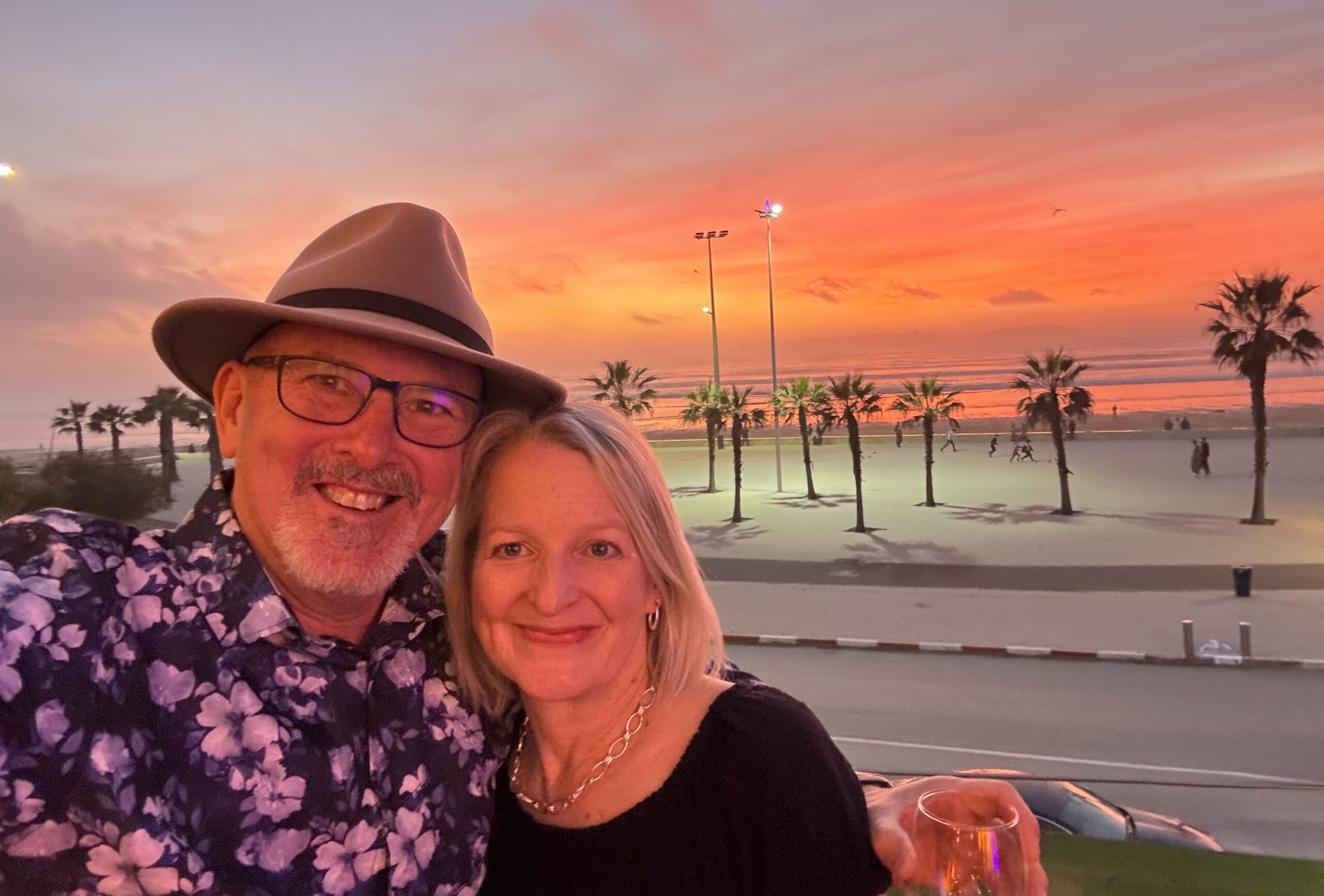
January, and this corner of North Africa is bathed in warm sunshine, a far cry from the sub-zero temperatures of the Alps last weekend, or the grey dreariness back home. But that doesn’t stop the locals from wrapping up for winter. In contrast, we saunter about in tee shirts.
And, in true Race Across the World style, we travelled with only with our rucksacks, having booked just the first few nights in advance. That flexibility allowed us to follow our noses, seek out new experiences, and chase the sun. Our compass was firmly set to seek out “blue sky”.

Thanks to the glorious conditions, we ended up staying longer in Essaouira, exploring nearby villages, markets, and untamed coastline. We started and ended the trip in Marrakesh.
Here are the highlights. It was a truly wonderful week.
ESSAOUIRA – A BOHEMIAN DREAMSCAPE
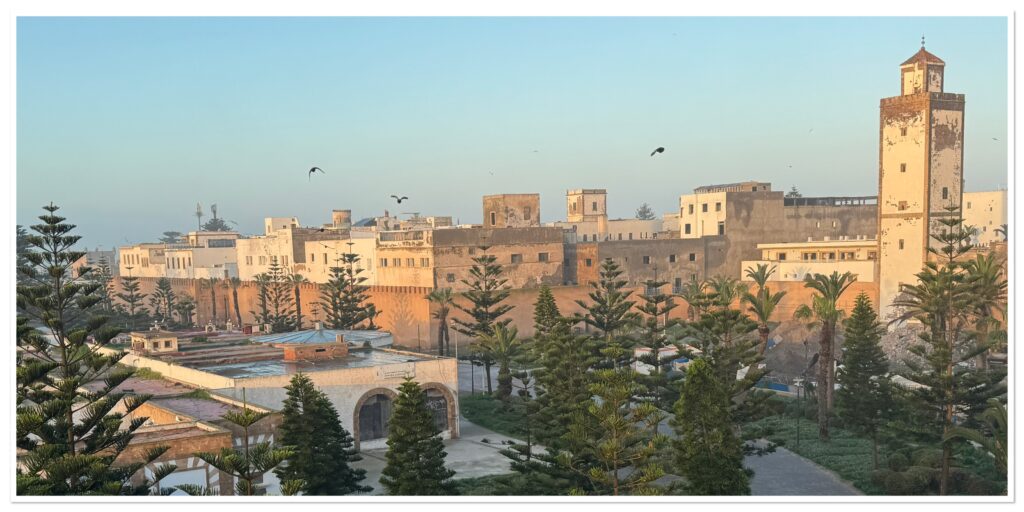
The coach from Marrakesh to Essaouira delivered stunning views of the High Atlas Mountains, which at this time of year are capped with snow.
Two years ago, we donned crampons to summit Mount Toubkal from base camp, but I don’t think we’d fancy that this time of year. At 13,671ft it would be a little more challenging with all that snow, so best left for spring or summer.
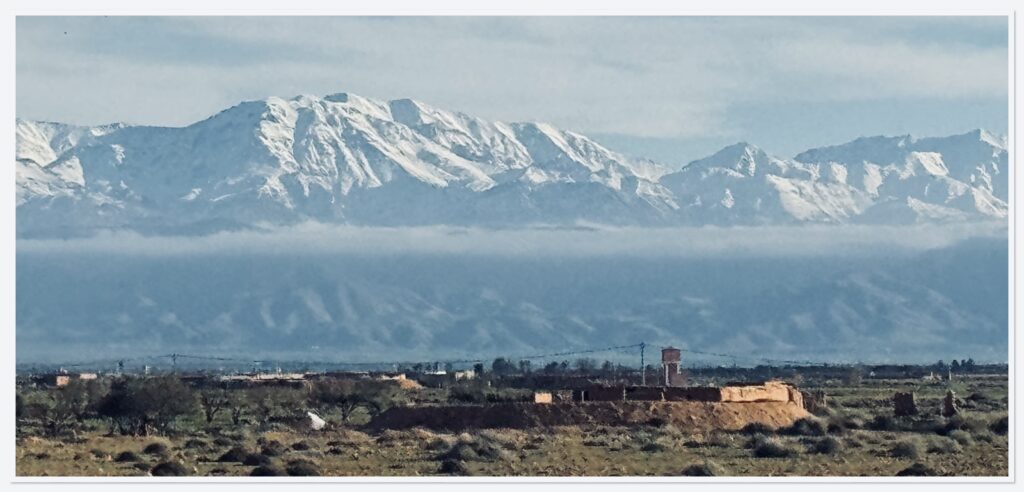
Essaouira remains one of our favourite places. This old fortress city is remarkable in so many ways. It feels like a huge step back in time, with a laid back bohemian vibe.
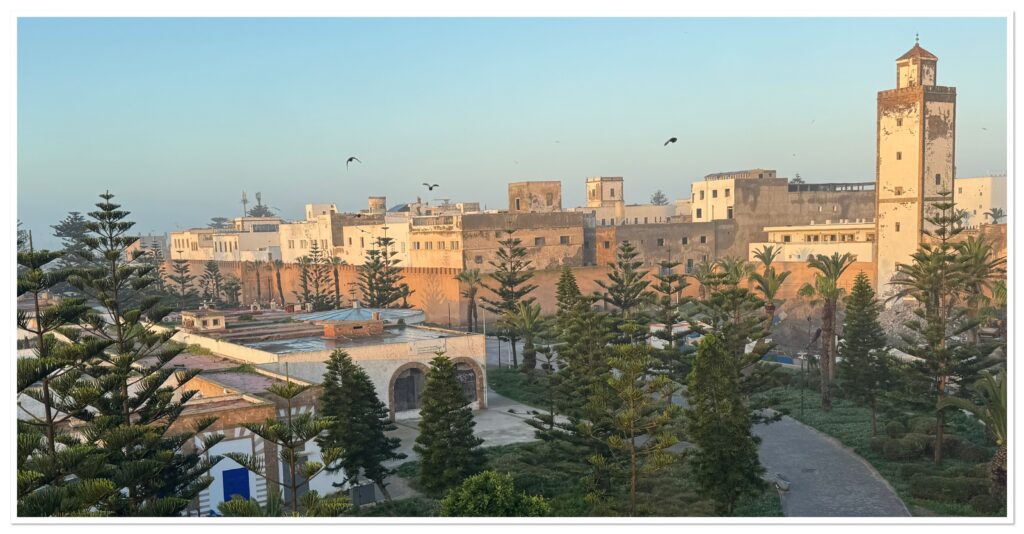
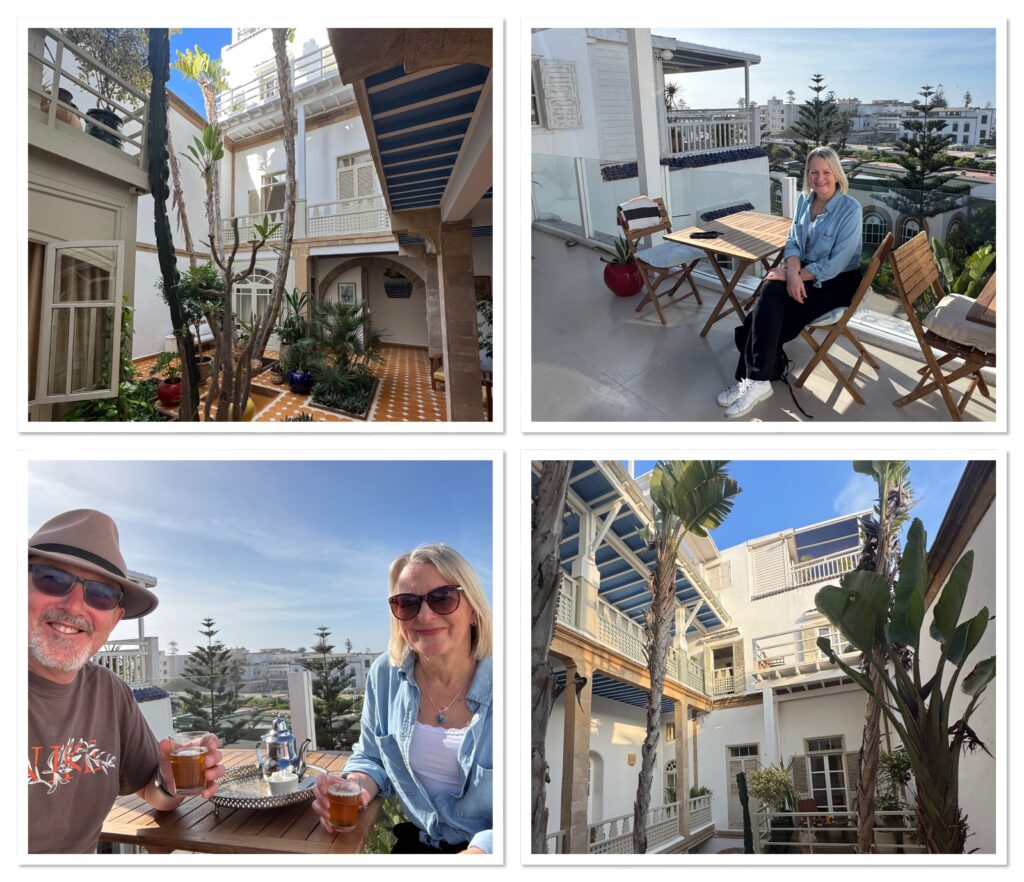
Booking at the very last minute, we found some fantastic bargains. Our first riad was fairly upmarket, but the second, perched atop the old city walls overlooking the Atlantic, was simply stunning. It was half the price I’d seen advertised weeks earlier, so we snapped it up immediately. Details in the Hints & Tips section.
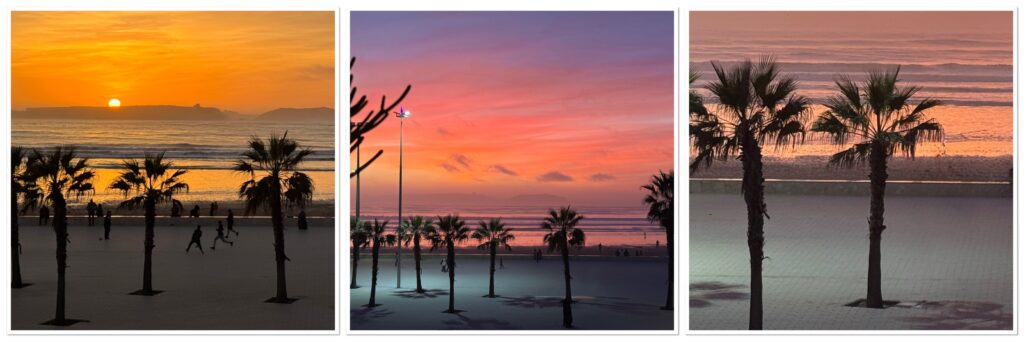
Essaouira is so different from the more popular Marrakesh: calm, relaxed, more hippy and reflective. The predominant colours are blue and white, and the medina is far smaller and easier to navigate.
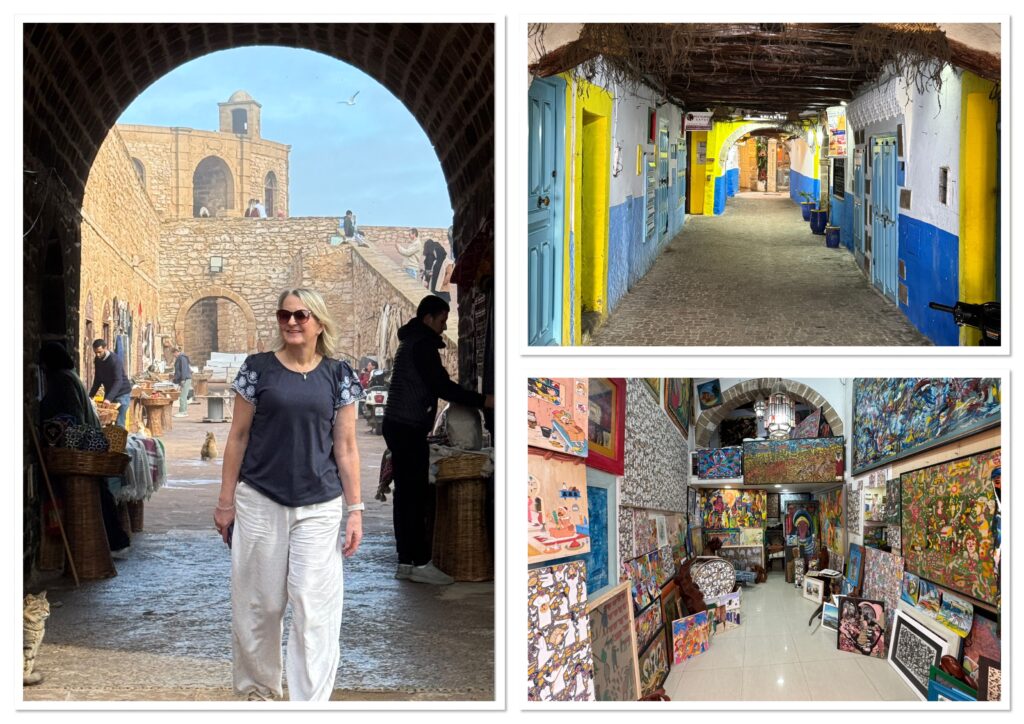
There are countless coffee shops where you can sit and watch the world go by, an abundance of artists and galleries, and cats. Lots of cats.
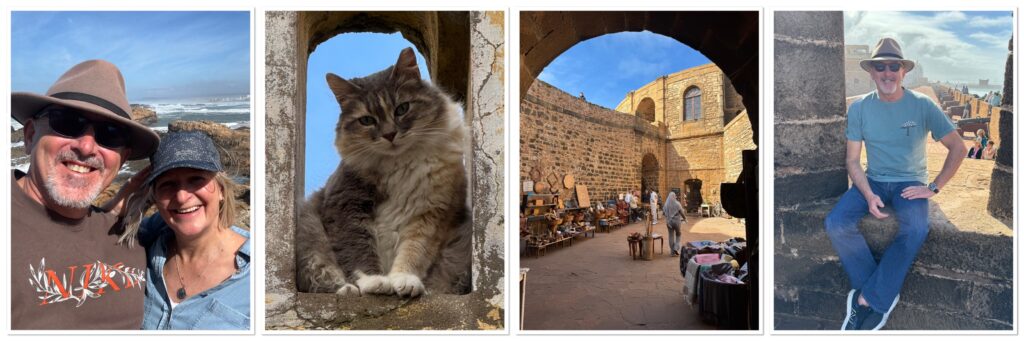
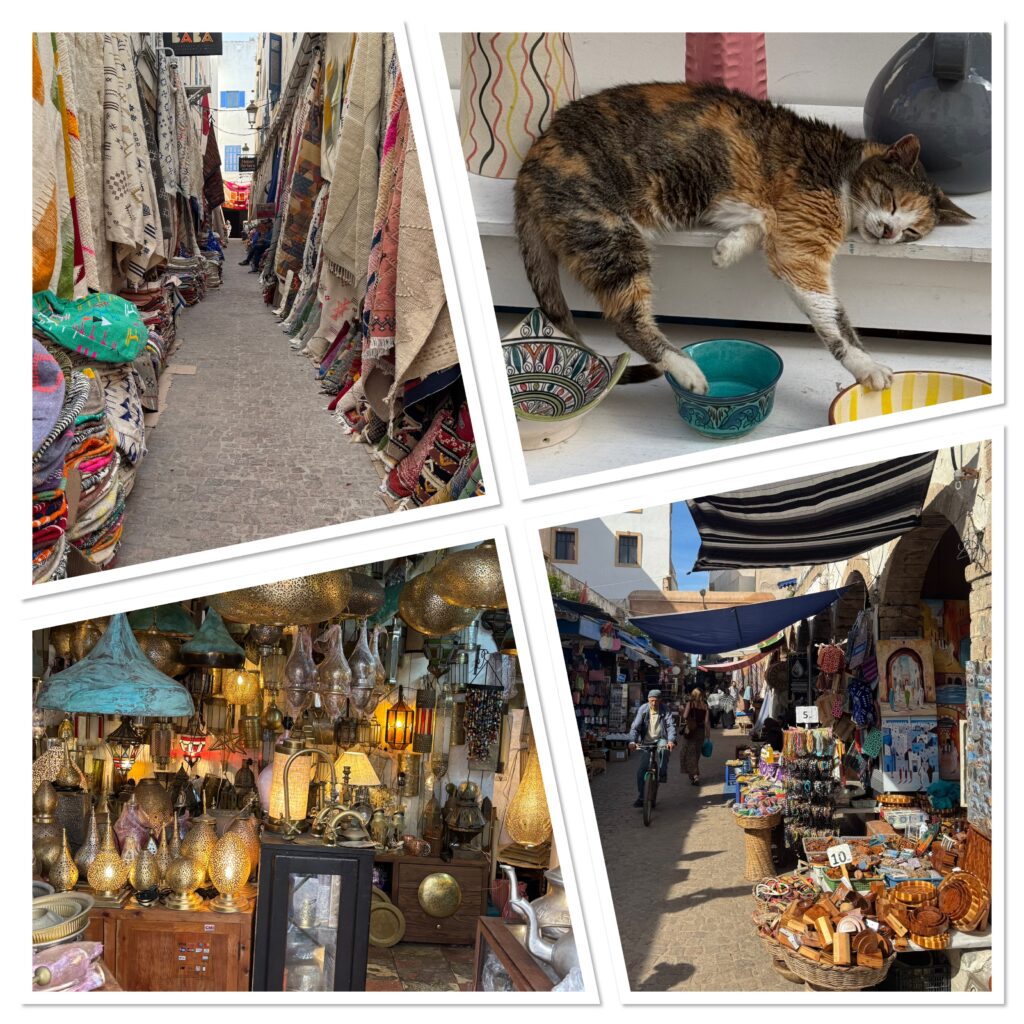
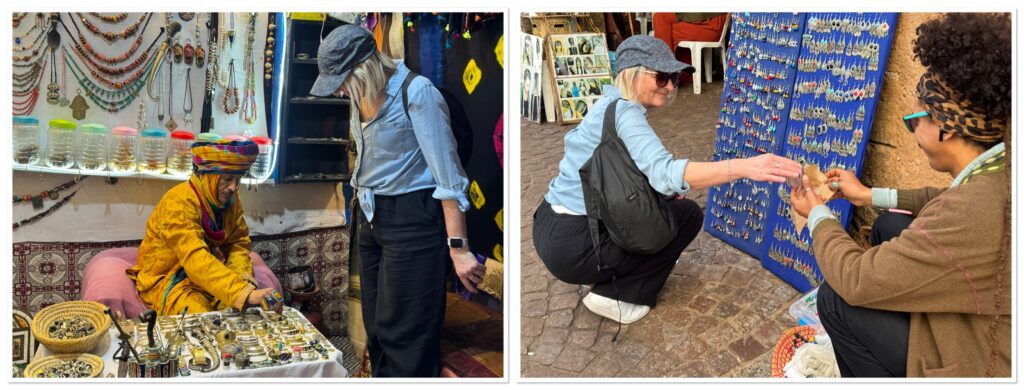
Buoyed by the empty streets and polite traders, Emma decided to try her hand (again) at haggling, with the same outcome as last time. Mind you, this is a woman who thinks she’s being daring when she pops something with an orange “reduced” label into a Waitrose trolley.
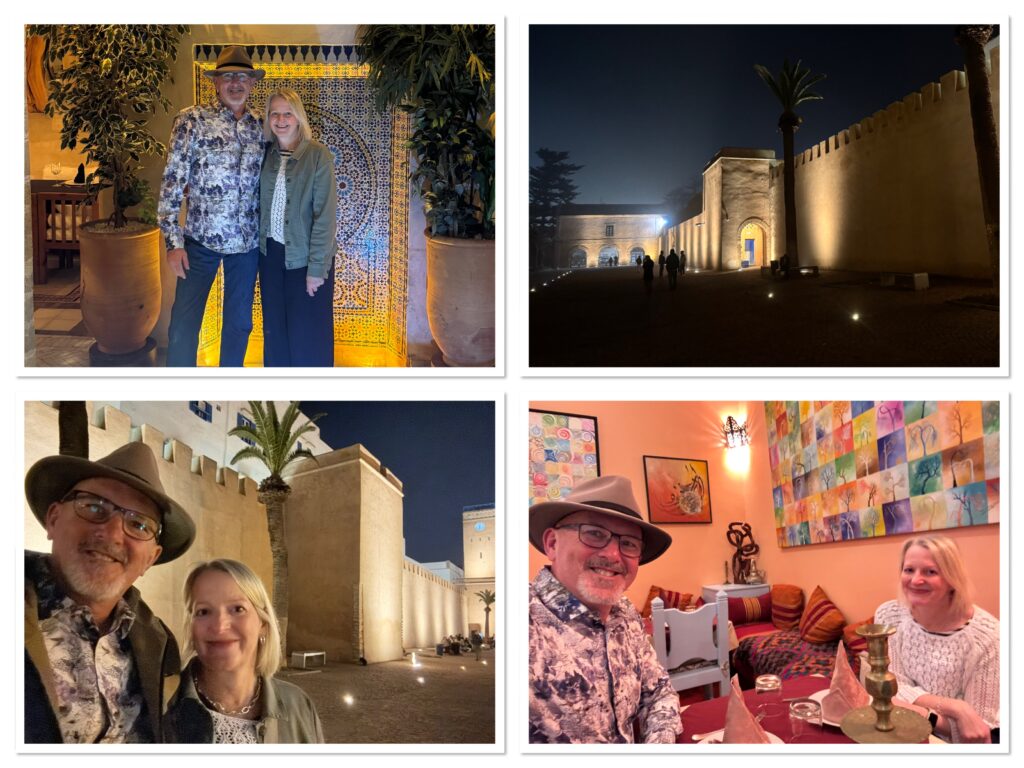
After sunset, the city wall lights come on, creating a soothing atmosphere that invites you to aimlessly wander the city. Hipsters, has-beens, and wannabes (like me) mingle with locals and traders late into the night. Everyone seems to be smiling, and why wouldn’t they? It’s a beautiful city full of hidden corners that deliver on its bohemian promise. The street entertainment here is outstanding, some of the best performers I’ve seen.
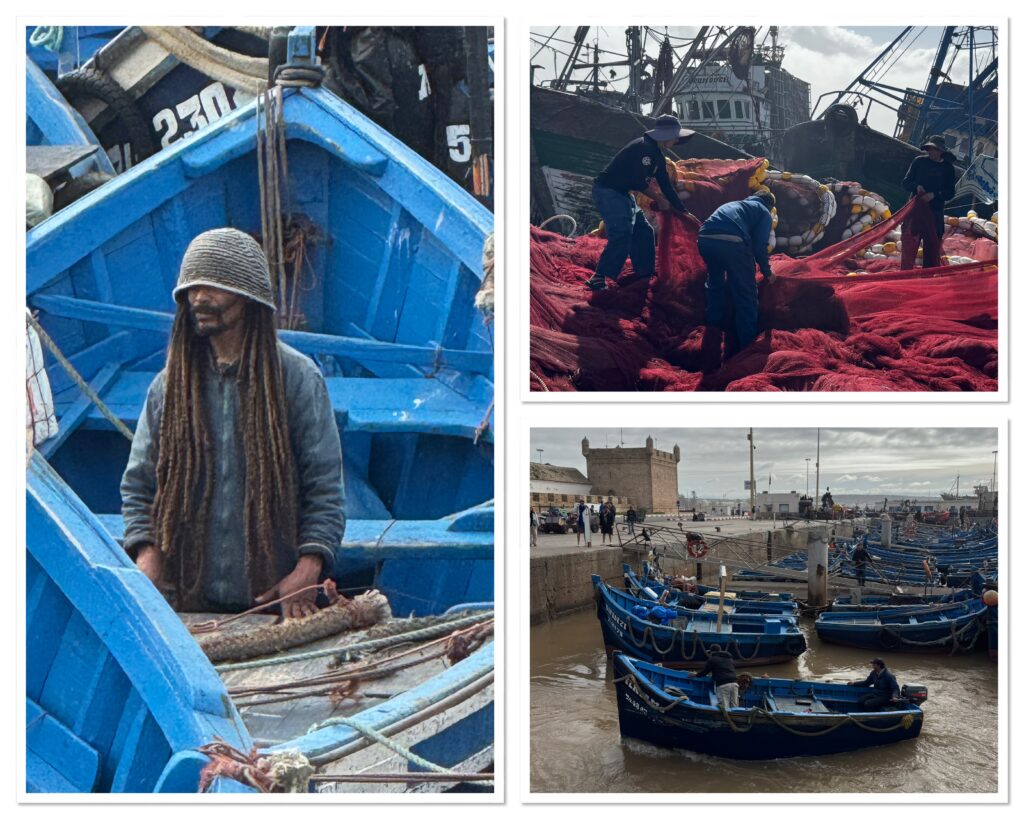
The shipping port was much quieter than on previous visits; I was told that this was largely due to winter storms battering the Atlantic. Most of the tiny blue fishing boats, along with all of larger sardine fleet, were tied up inside the sanctuary of the harbour.
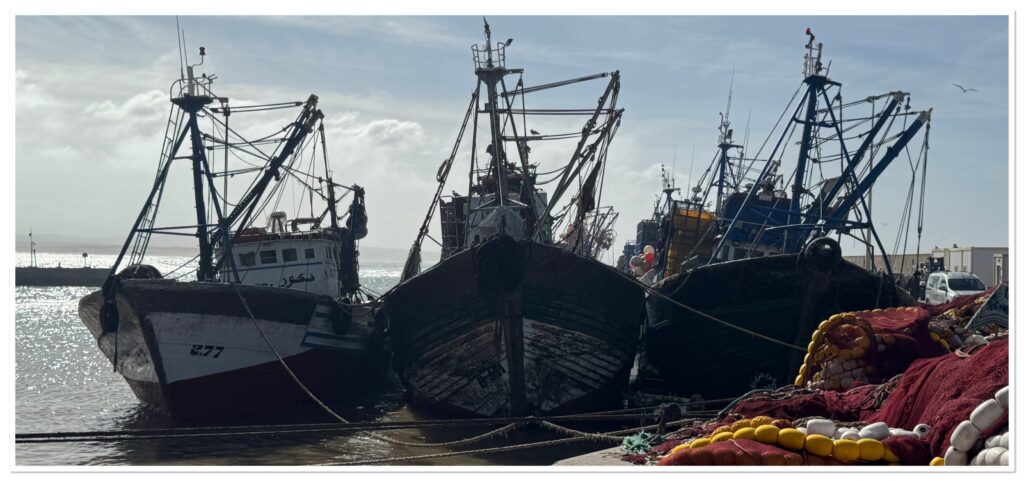
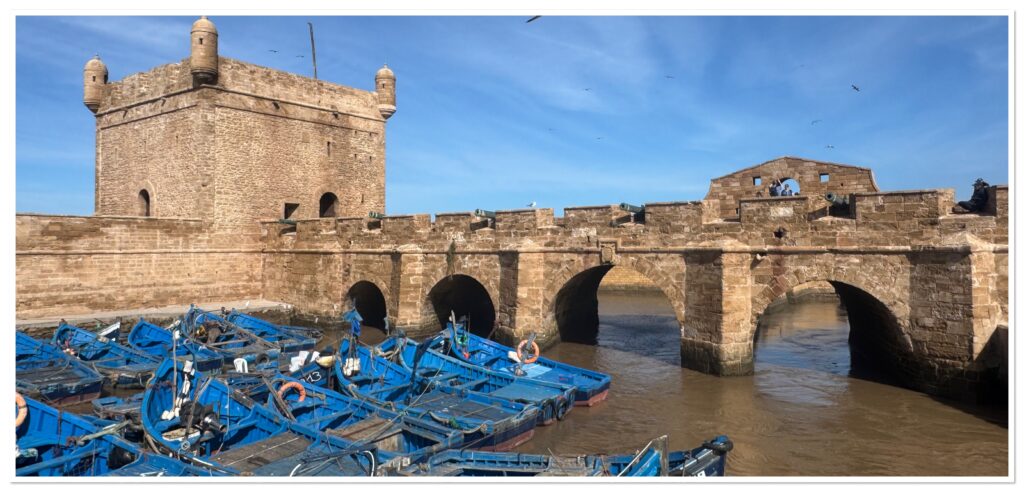
This meant maintenance work for the fishermen, who, as we learned last time, only get paid based on their most recent catch. It’s a tough life for the locals who rely heavily on this trade.
With such a compact medina, it’s easy for us to nip back to our accommodation, freshen up, and head out again for food or a glass of wine. We always eat well in Essaouira, it’s not difficult to find fantastic quality and good value – at every price point. And we always choose local Moroccan wine over the French imports; it somehow tastes better here, but I’m not sure how well it would travel!
We discovered a few new places this time, including a great little restaurant about ten minutes outside the city walls where the food was half the price and the portions double in size. We also ate superbly at a small place next door to our accommodation. Both were excellent — details again in Hints & Tips.
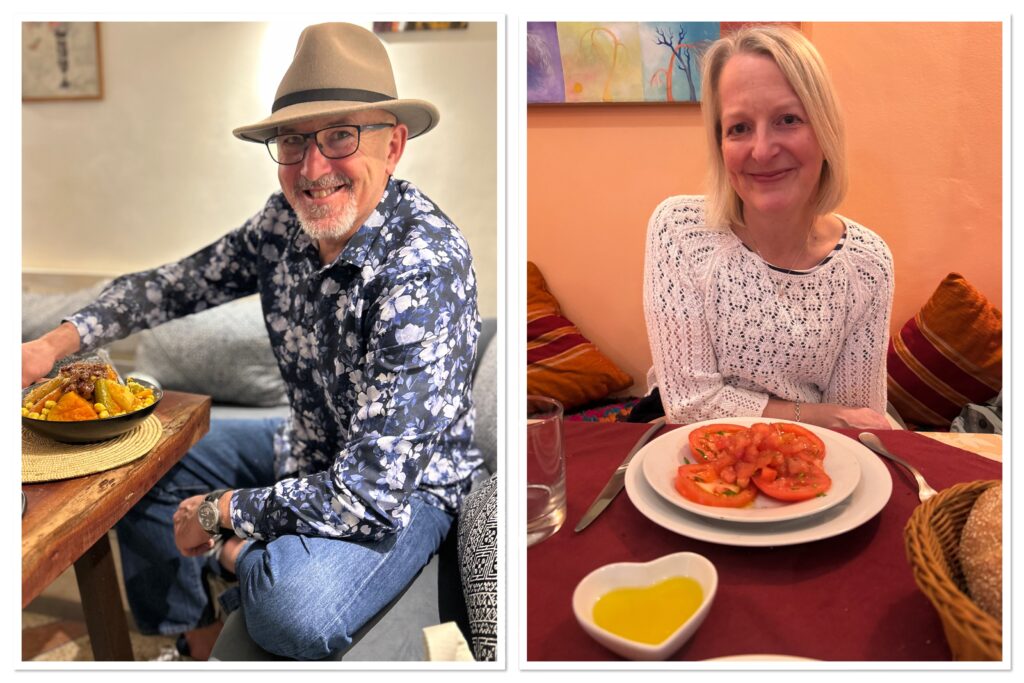
At the former, we got chatting to the manager, who seemed surprised to see us so far outside the medina. He shared a few local recommendations for the rest of our trip – advice we happily followed.
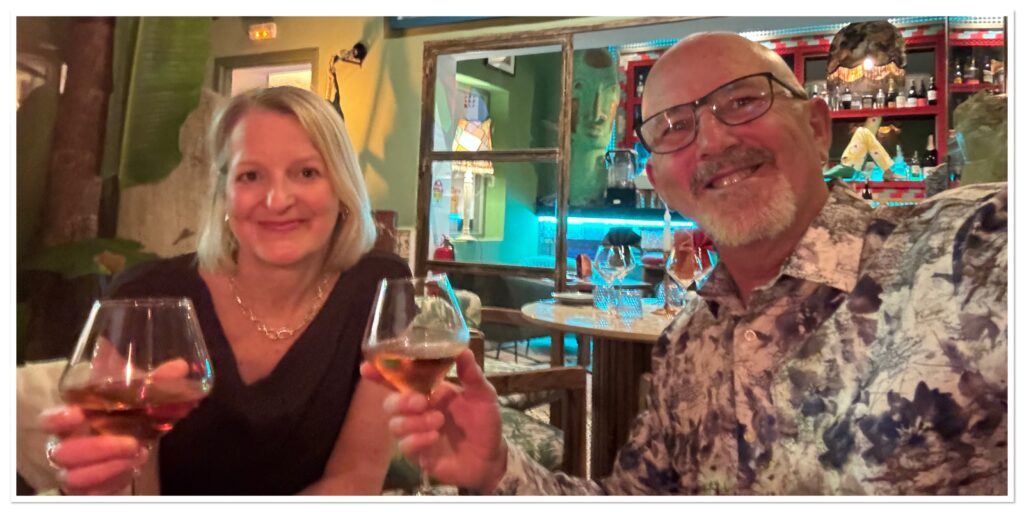
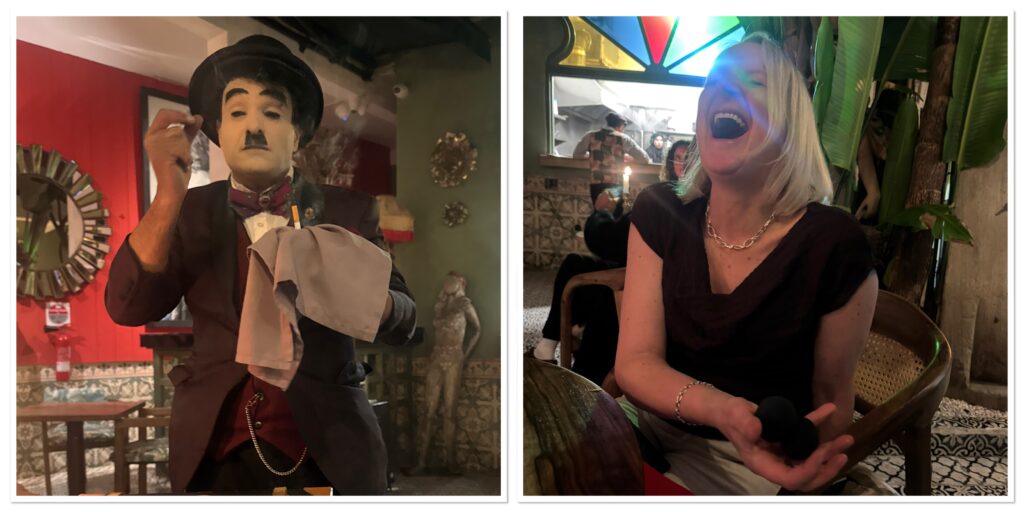
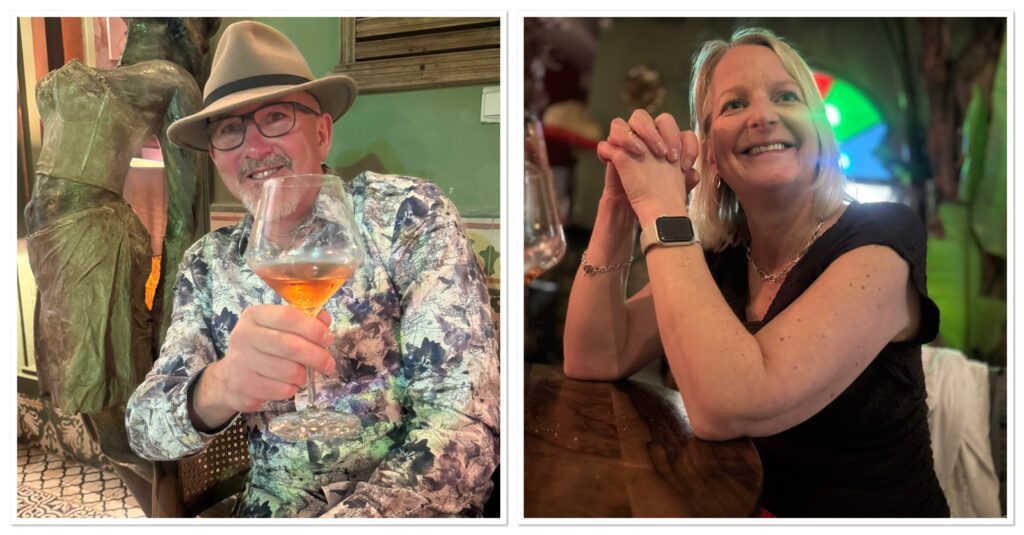
For a touch of decadence, we visited Le Love by Caravane, a quirky little restaurant hidden down a narrow alley just off Avenue de l’Istiqlal. We were even treated to some impromptu local “entertainment”, it was enormous fun.
MARKET DAY – SOUK EL HAD DU DRÂA
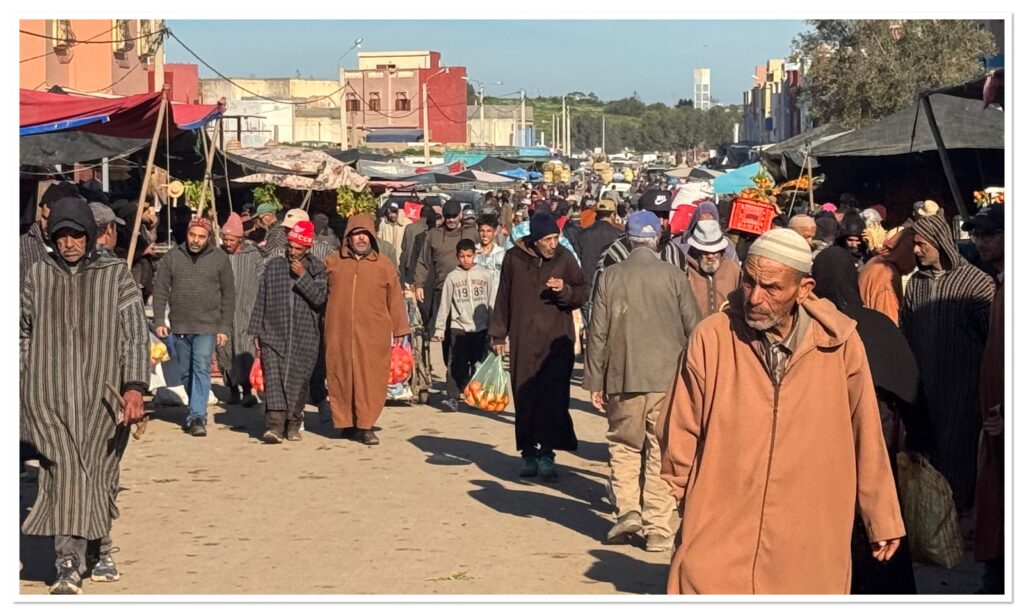
As we approached Souk El Had Du Drâa, the roads grew busier, with cars giving way to people, donkeys, and carts. Our driver parked a few hundred yards from the souk entrance, leaving the car in the care of some local “minders” who, much like the scallywags and street urchins of London’s old East End, offer to “look after” your vehicle for a few coins. Woe betide the driver’s car if he doesn’t cough up (although I think it’s more of a threat than a promise)!
Stepping into the souk felt like travelling into a bygone era with rituals and scenes that have been repeated for centuries.
It was thirteen hectares of pure mayhem.
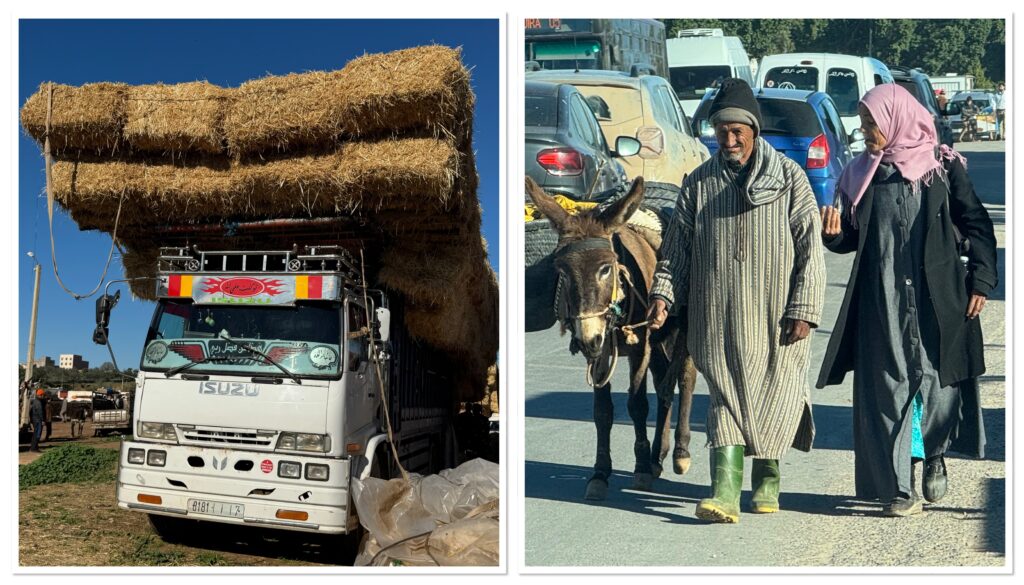
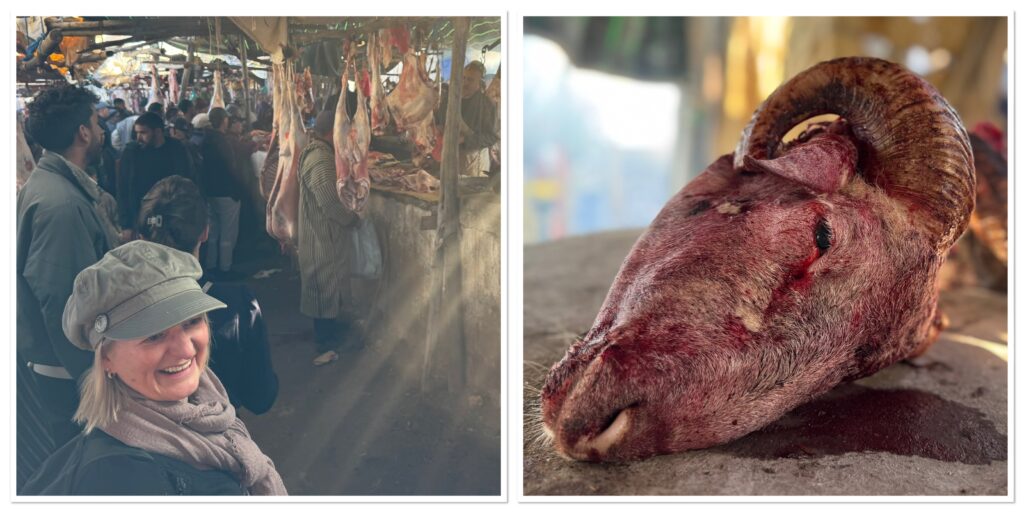
This is very much a male-dominated space: few women, and even fewer Europeans. The photo (above right) may offer a clue as to why the women stay at home. Just look at those faces….I suspect she was nagging him about putting up those shelves – again!
My guess is he’ll be on his own next week!
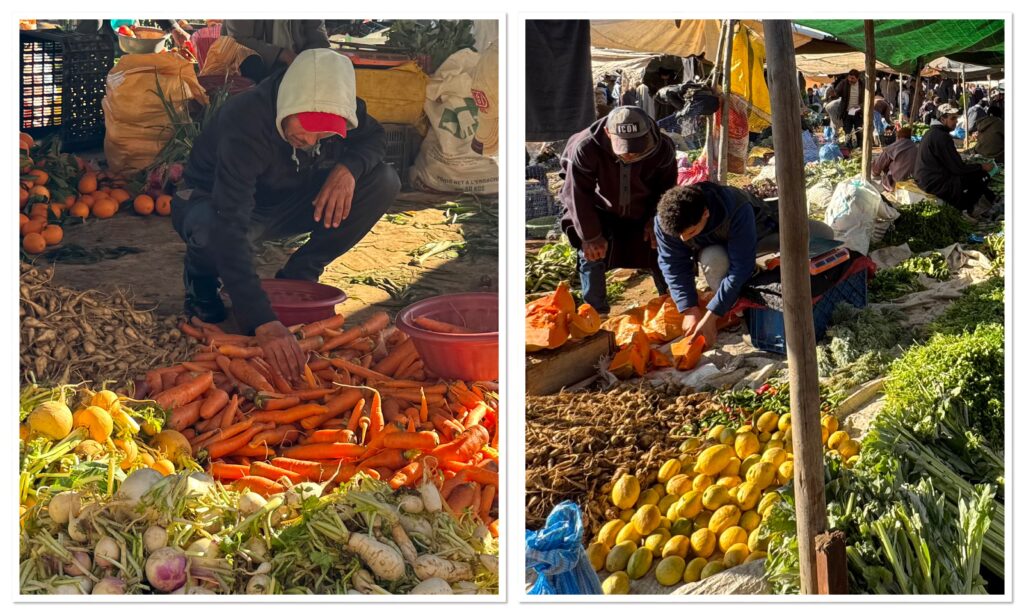
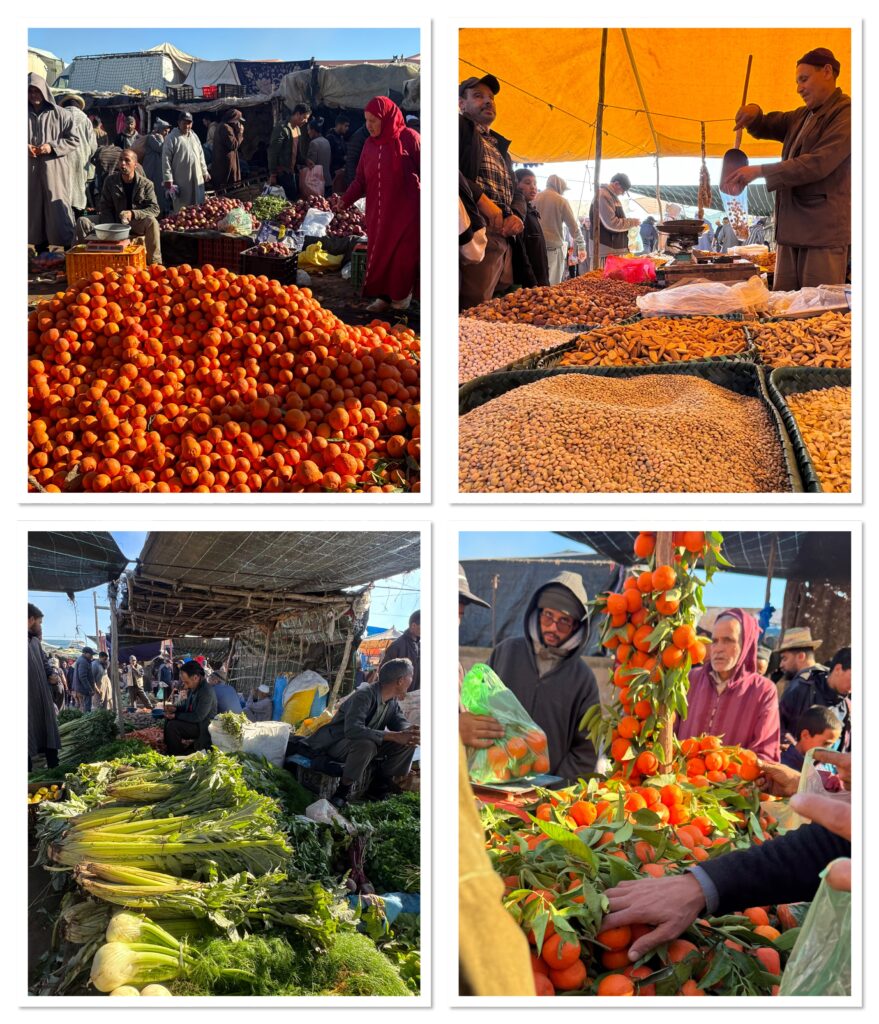
The fruit and vegetable section was pleasant enough, filled with familiar aromas that took me straight back to childhood. This is what produce used to smell like in the UK before everything became overly sanitised and pre-packed.
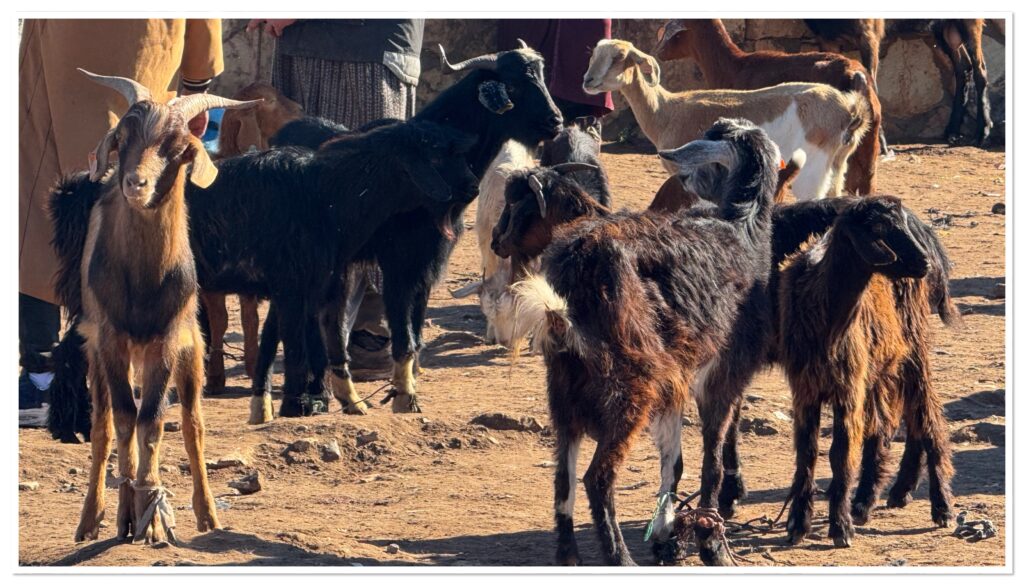
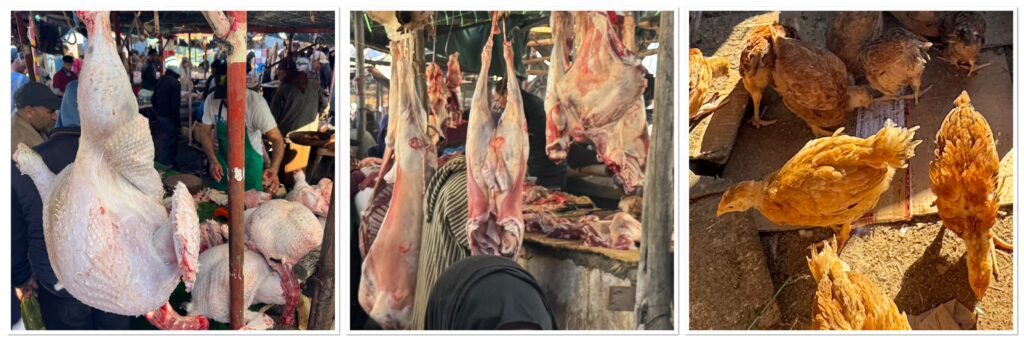
Deeper into the souk, the scenes became more authentic, rustic, and brutal. The livestock area was packed full of sheep, goats, and cattle, though I’m told the best specimens are traded early in the morning for serious money.
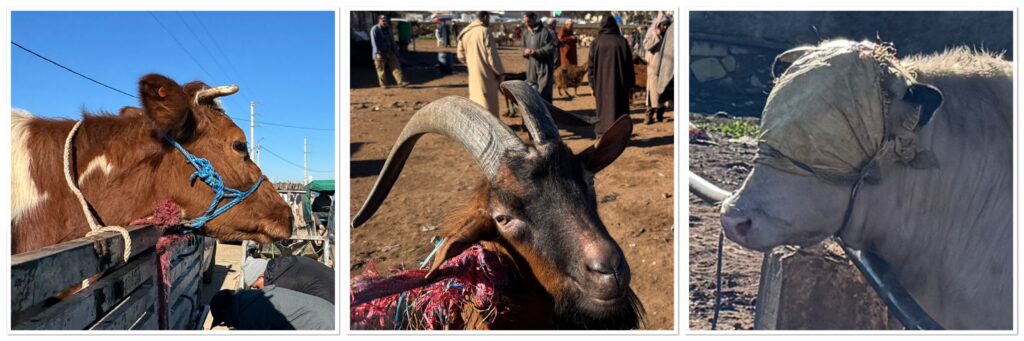
This is not for the faint-hearted and animal welfare doesn’t seem high on the agenda. That said, my Welsh friends would love it here; with all the tied up sheep they’d probably mistake it for a “leisure centre”.
Emma, a vegetarian for decades, was contemplating a return to that lifestyle after passing one butcher with his next “victim” tied up awaiting its fate.
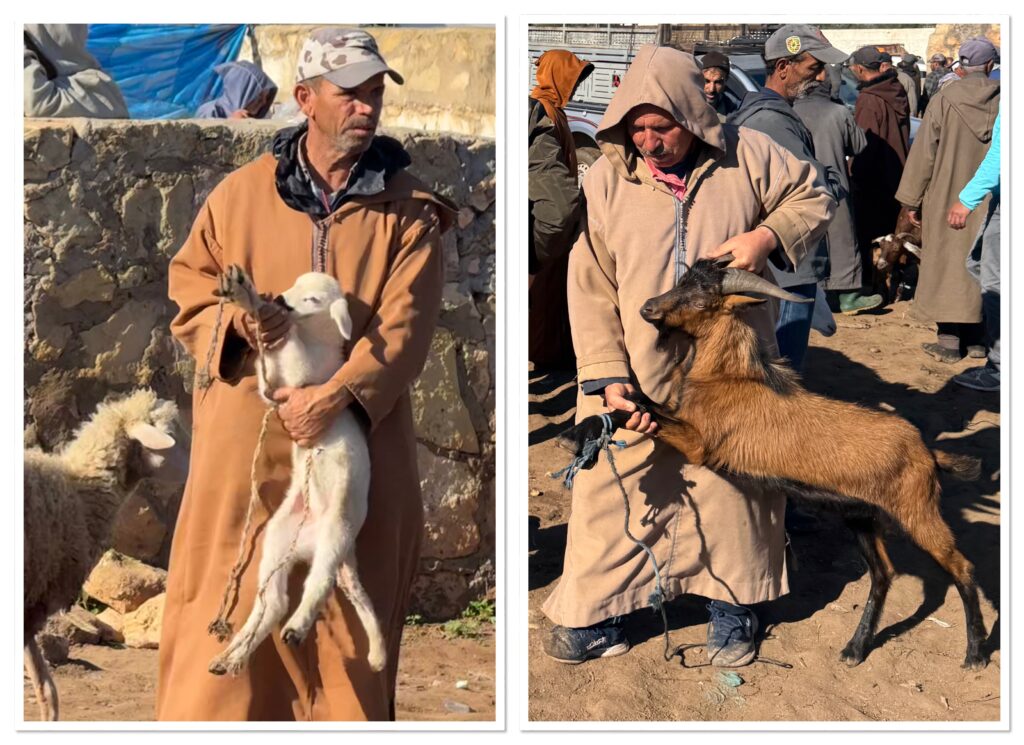
It’s all very primitive compared to our Western experience, where meat arrives neatly wrapped in cellophane with labels and barcodes.
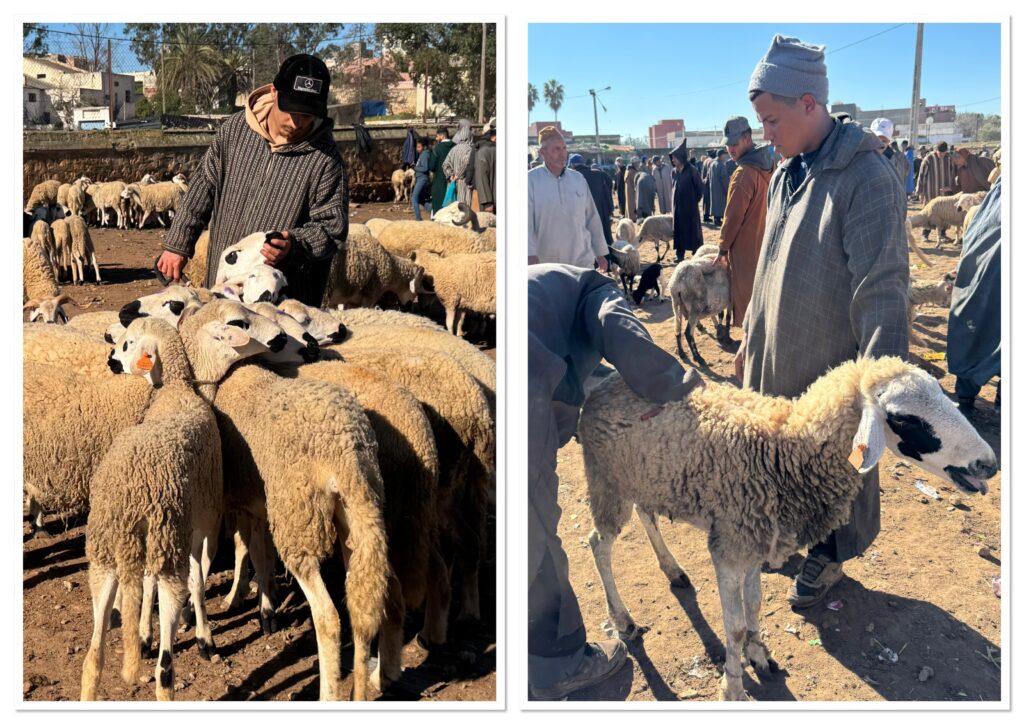
Still, there’s something refreshingly honest about it: nothing is wasted, every part of the animal is used and eaten.
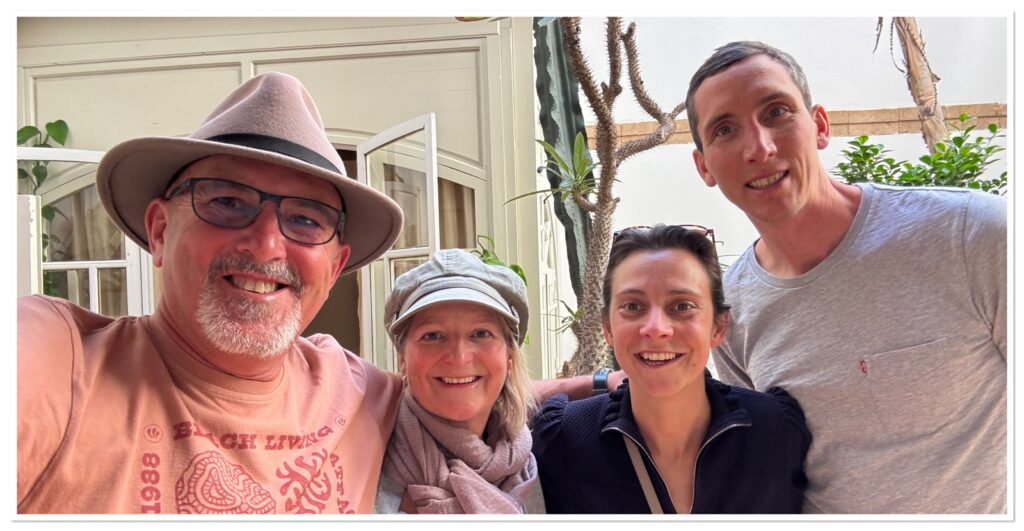
All too soon, our souk visit came to an end. We said goodbye to Frédéric and Marine, a couple we’d met over breakfast at our riad and shared both the taxi ride and the experience with. Their flight home to Paris had been cancelled, gifting them an extra day in Morocco, a definite win.

SIDI KAOUKI
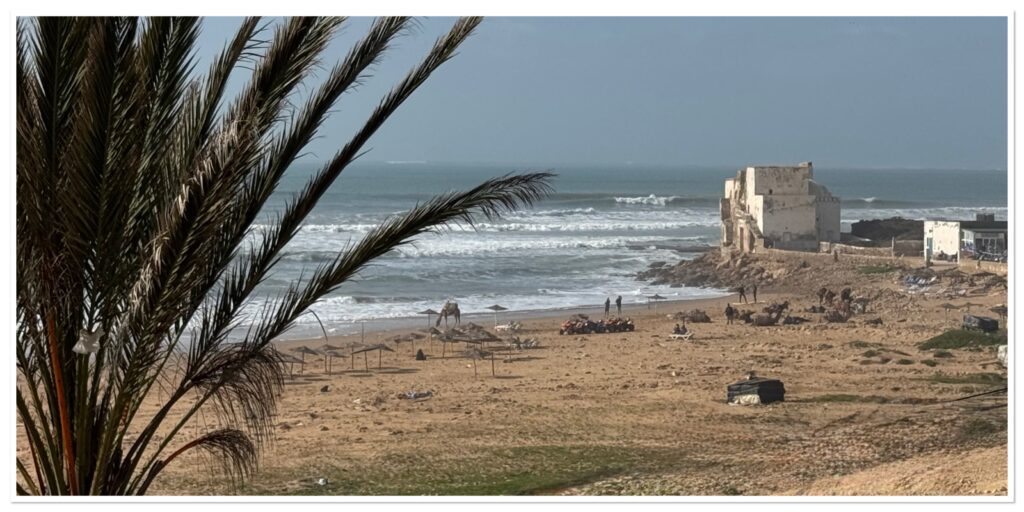
South of Essaouira lies the small coastal village of Sidi Kaouki, so we decided to head down for a few hours to soak up the sun and stretch our legs.
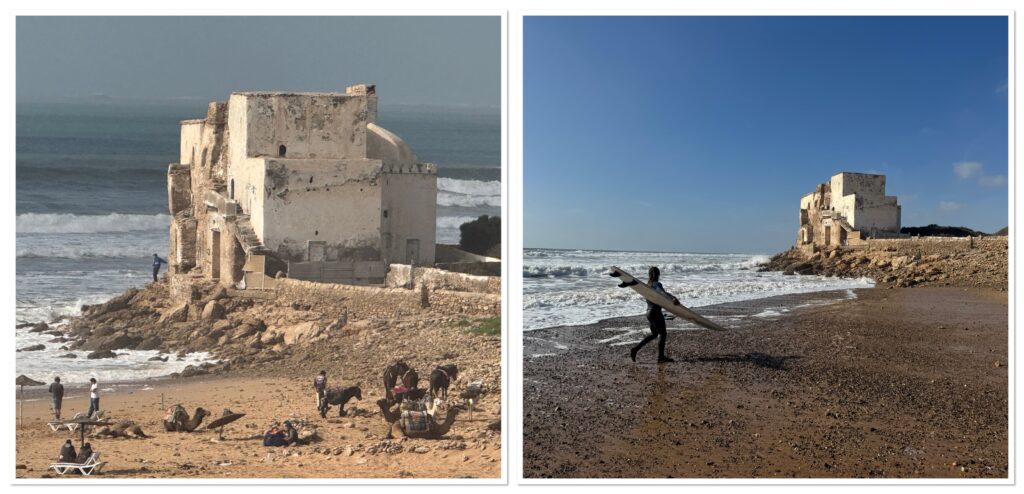
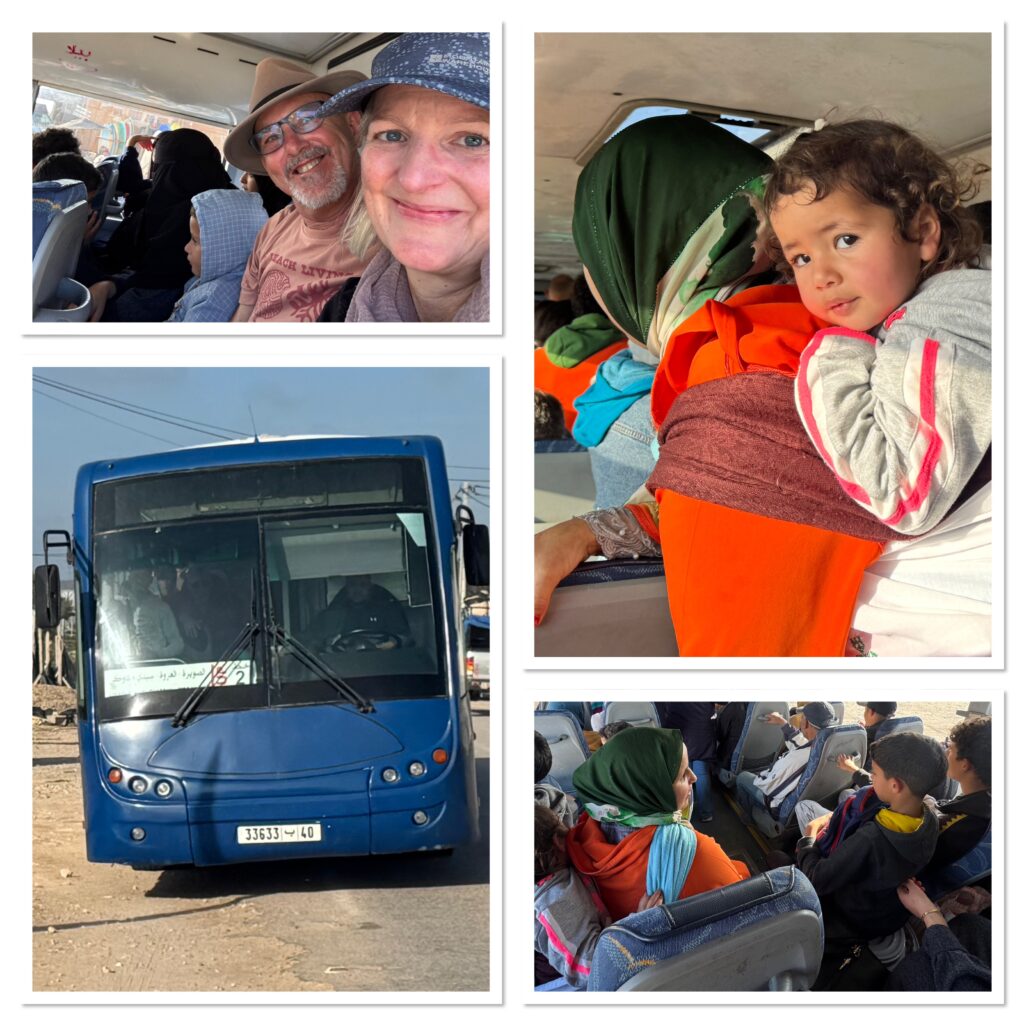
A bit of research revealed that for just 8DH (around 70p), a public bus would take us there. We found the stop about 30 metres from Bab Doukkala gate (the most northern gate of the Medina) and waited for the number 2 ‘Limabus’. The journey took roughly 45 minutes and was used mainly by locals with a handful of tourists and traveller types.
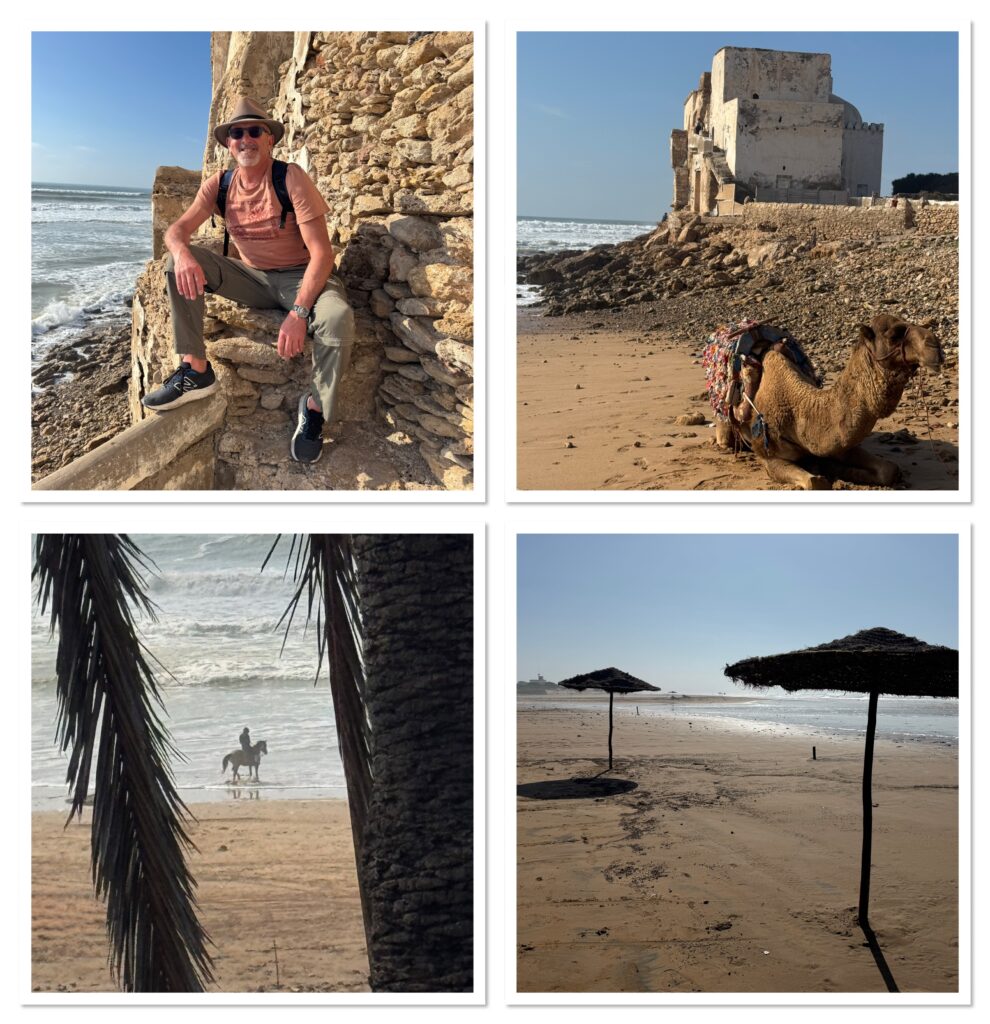
It’s well worth a visit for an afternoon, or longer if you’re into surfing, though I’d say it lacks the magic of beaches further south like Imsouane or Taghazout. Perhaps I needed to give it more time, or spend an afternoon collecting the plastic waste that appears invisible to many locals.
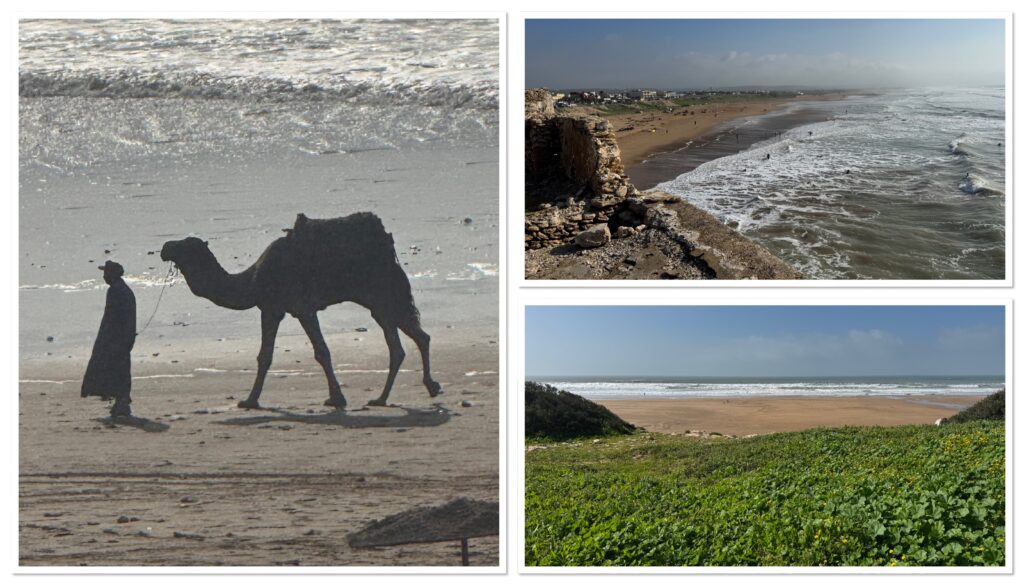
That said, it’s undeniably picturesque, just be careful what you frame in your photos. The litter is the one thing that lets the area down which is a tad disappointing.
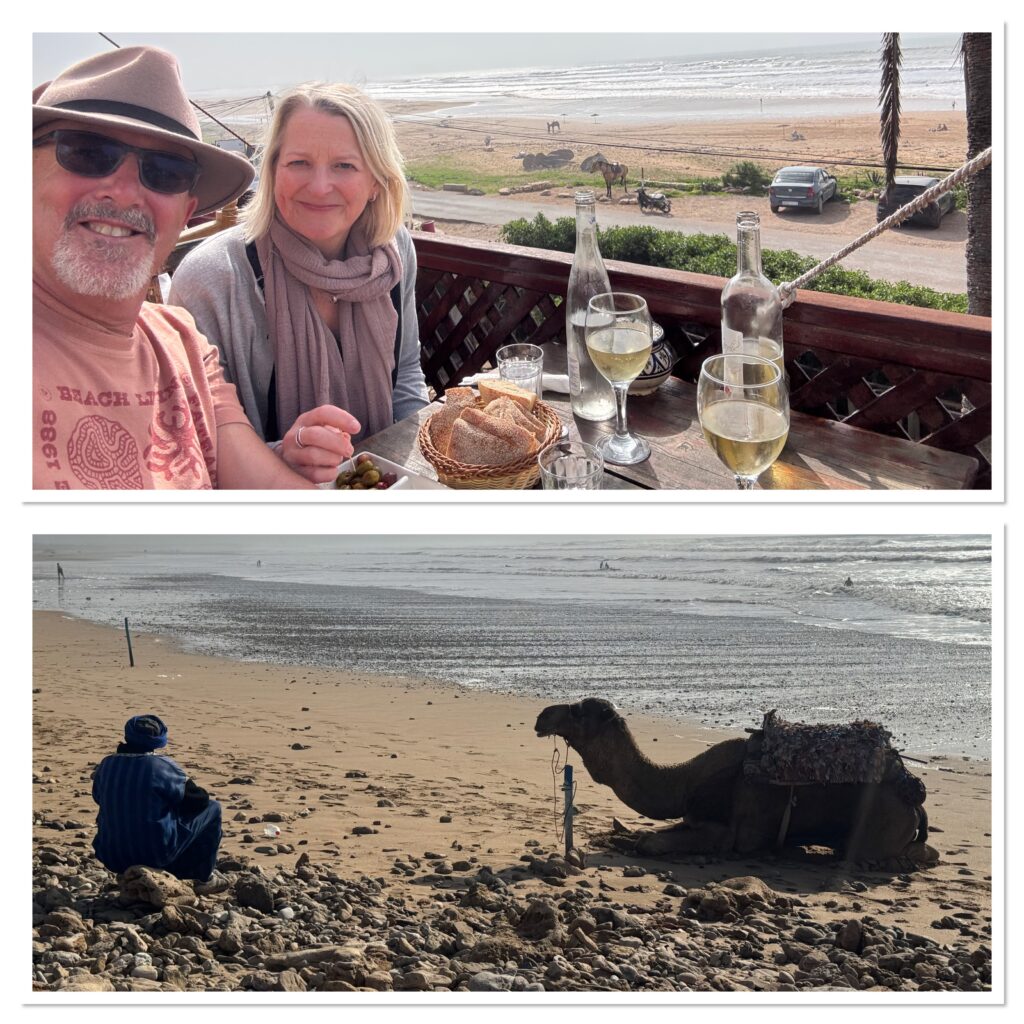
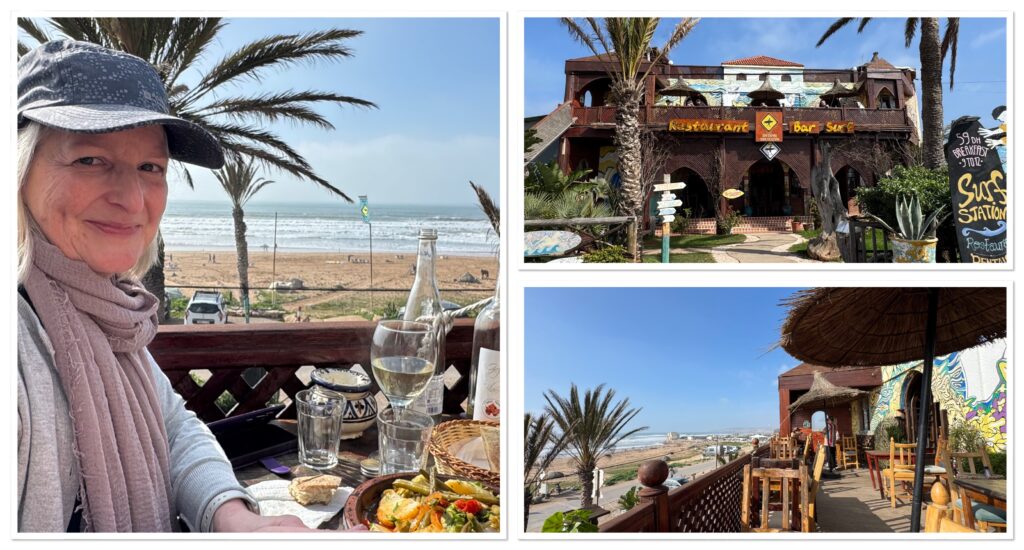
We stopped for lunch at a laid-back surf shack serving local wine before catching the return bus. Luckily, we arrived early, as it was standing-room-only and filled mainly with locals heading home from school and a day’s work.
A kind woman instructed her two boys to give up their seats for Emma and me, placing one child on her lap and the other on her shopping crate in the aisle. A small, touching and well received gesture.
MARRAKESH
Our experience here was in two parts. Initially we came here for one night upon our arrival in Morocco. We then returned for two nights at the end of the trip. Our flight to and from the UK were via Marrakesh Menara Airport.
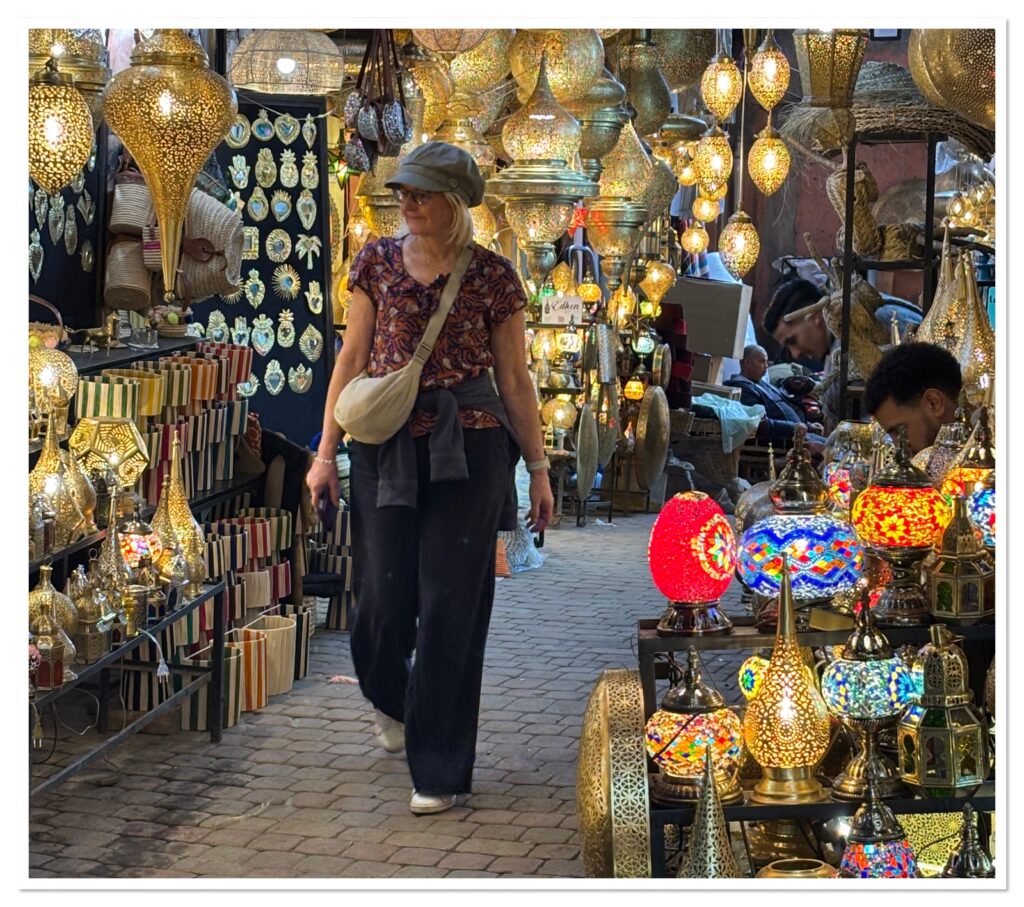
Travelling just outside high season meant fewer crowds and a calmer medina.
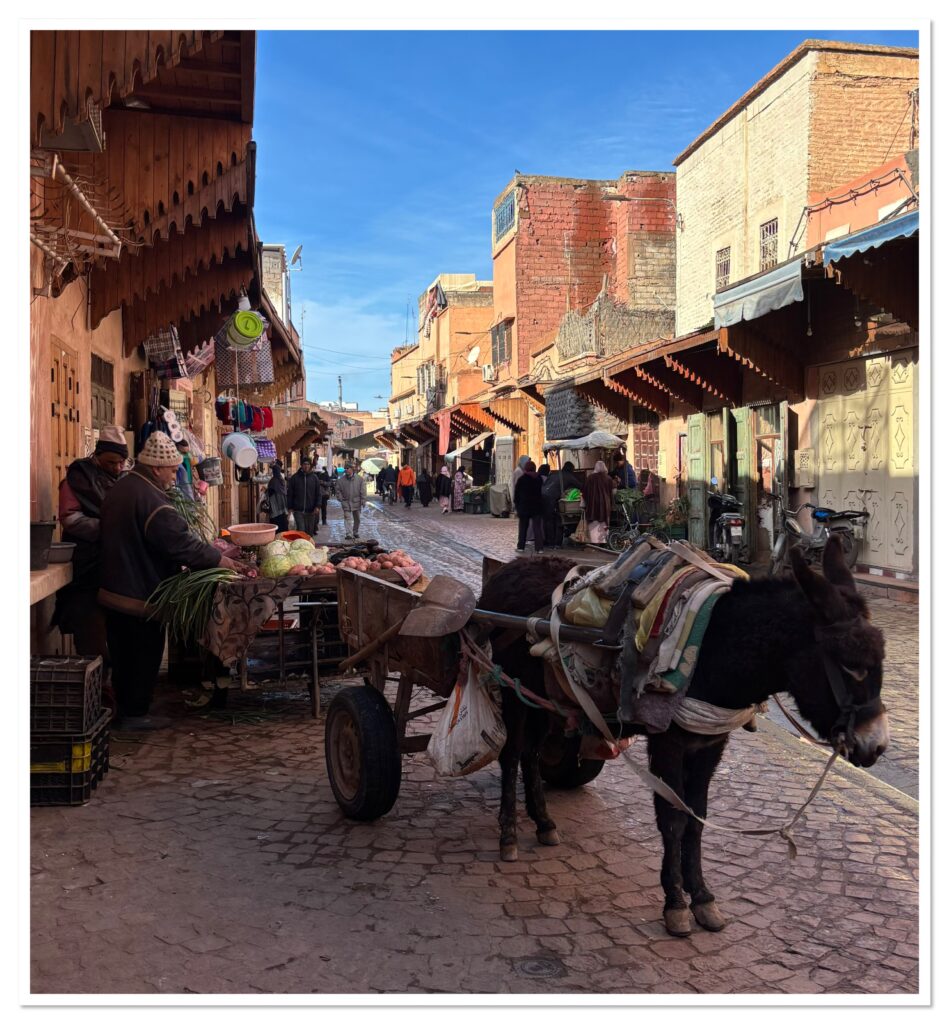
Our first visit here before heading to Essaouira was glorious, warm and sunny, while the second saw us return under dark clouds. For the first time in Morocco, we experienced rain. Thankfully, it was short-lived and the sun returned the following morning.
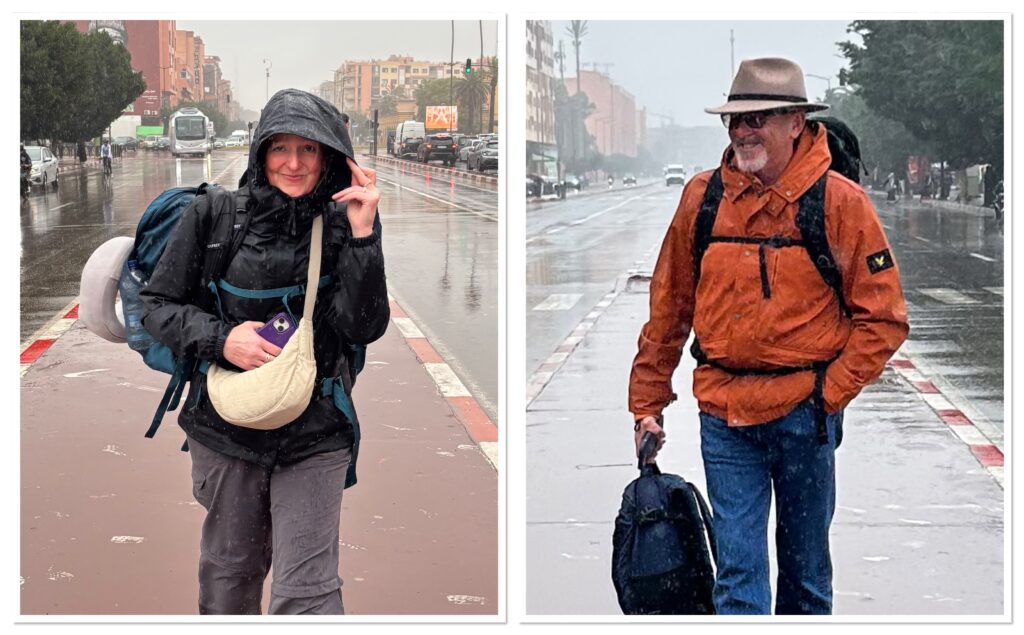
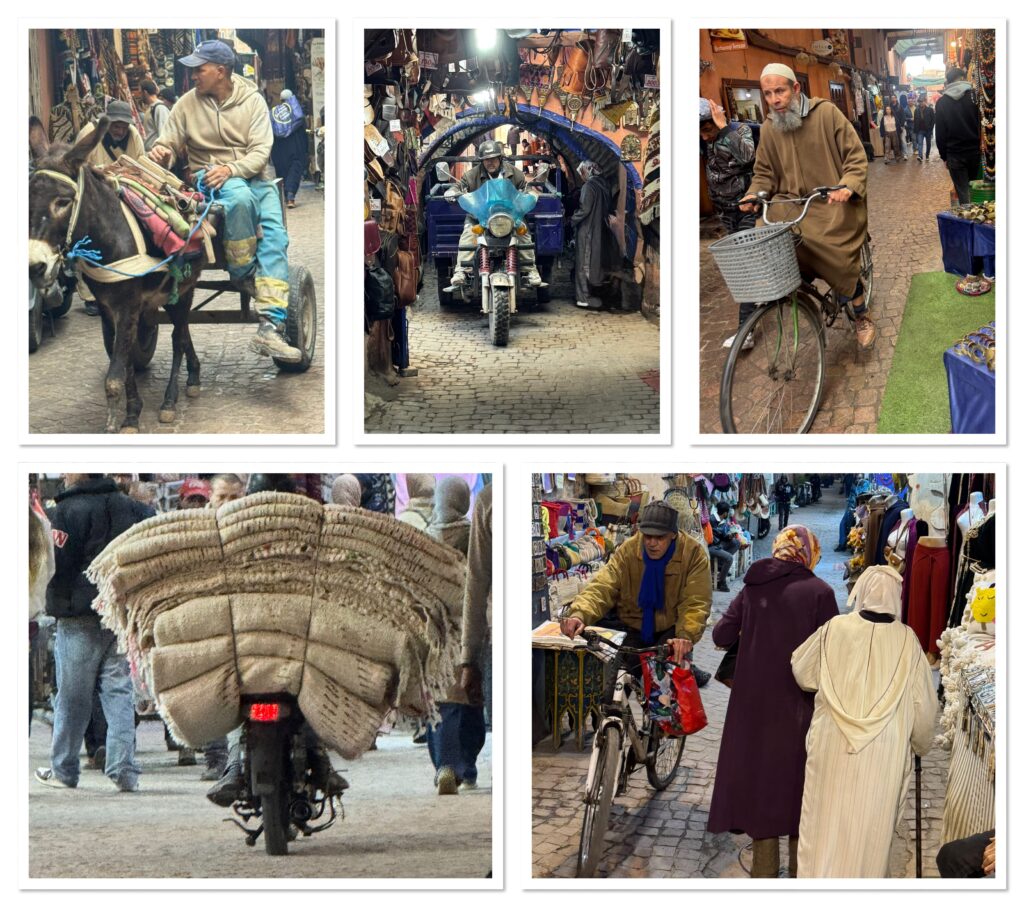
Stallholders and shopkeepers seemed noticeably less noisy and aggressive than on previous visits, or perhaps they’re learning that many Europeans shy away from hard-sell tactics. Either way, it meant we could wander the medina more freely, stopping to browse without feeling harassed.
Of course, there was still the constant soundtrack of motorbikes, bicycles, three-wheelers, and shouted warnings from men pushing heavily laden carts through narrow alleys. Somehow, Emma felt far more at ease this time, not a single shriek of terror!
We revisited an old favourite, Café Arabe, this time opting for the rooftop terrace rather than the swanky restaurant downstairs. Both are excellent, though the latter suits an evening meal better.
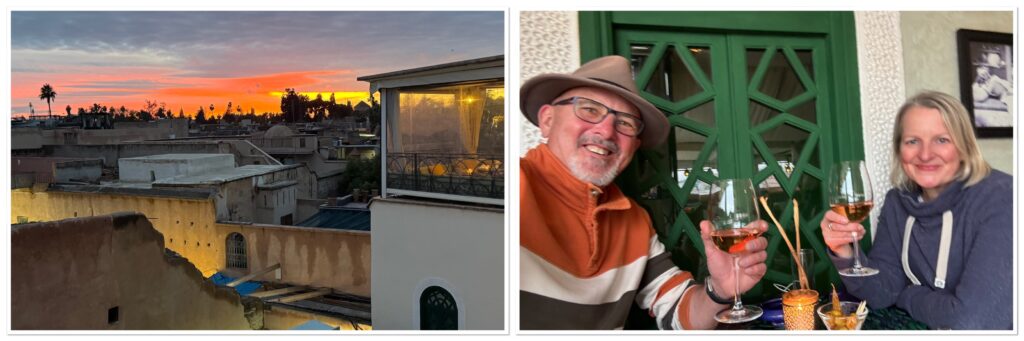
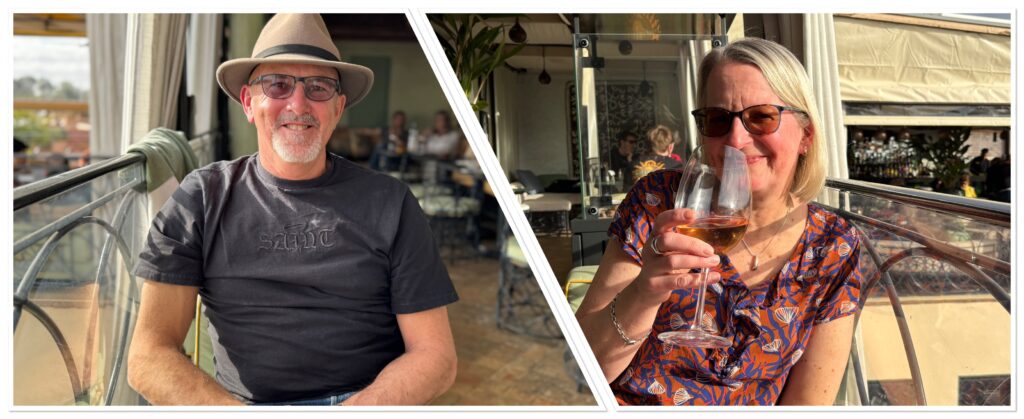
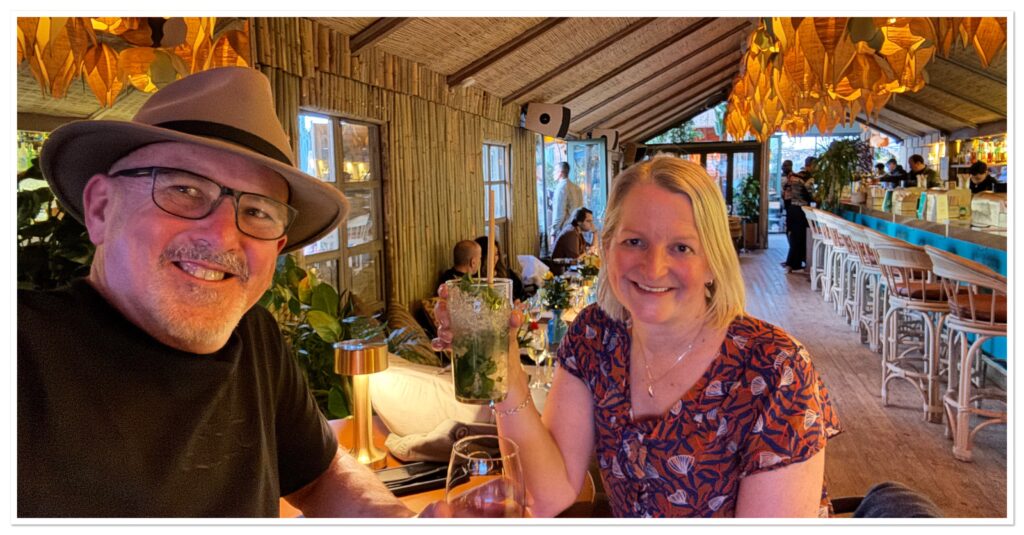
We rounded off the trip with a final nightcap at Kabana rooftop bar which is pricier, packed with Europeans, and very London-priced, but with great views and impeccable service.
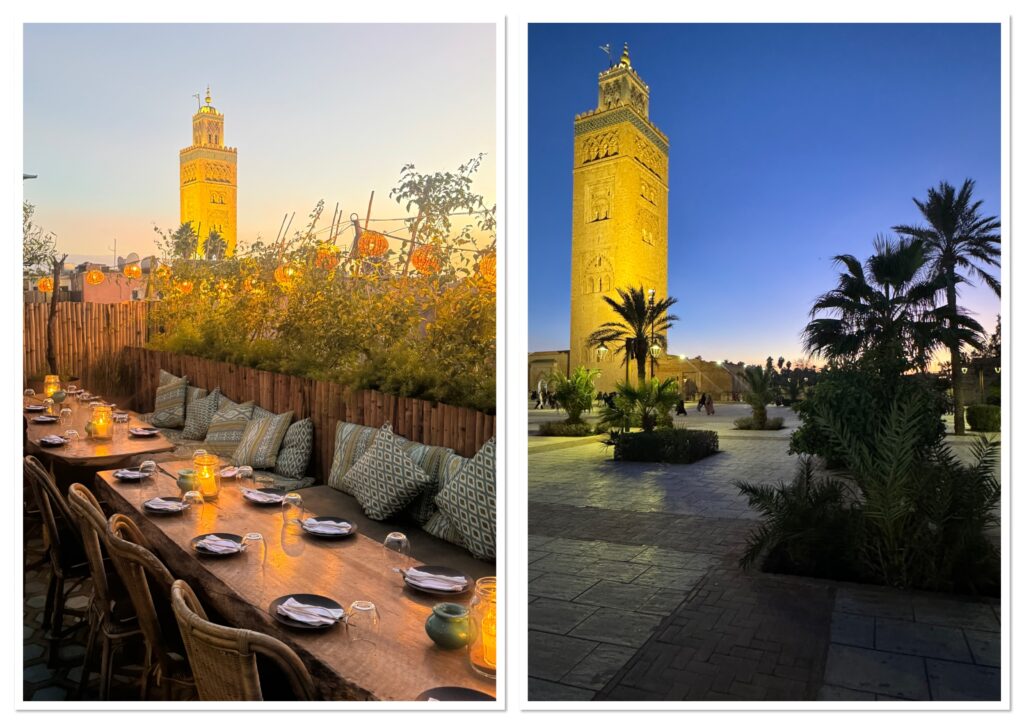
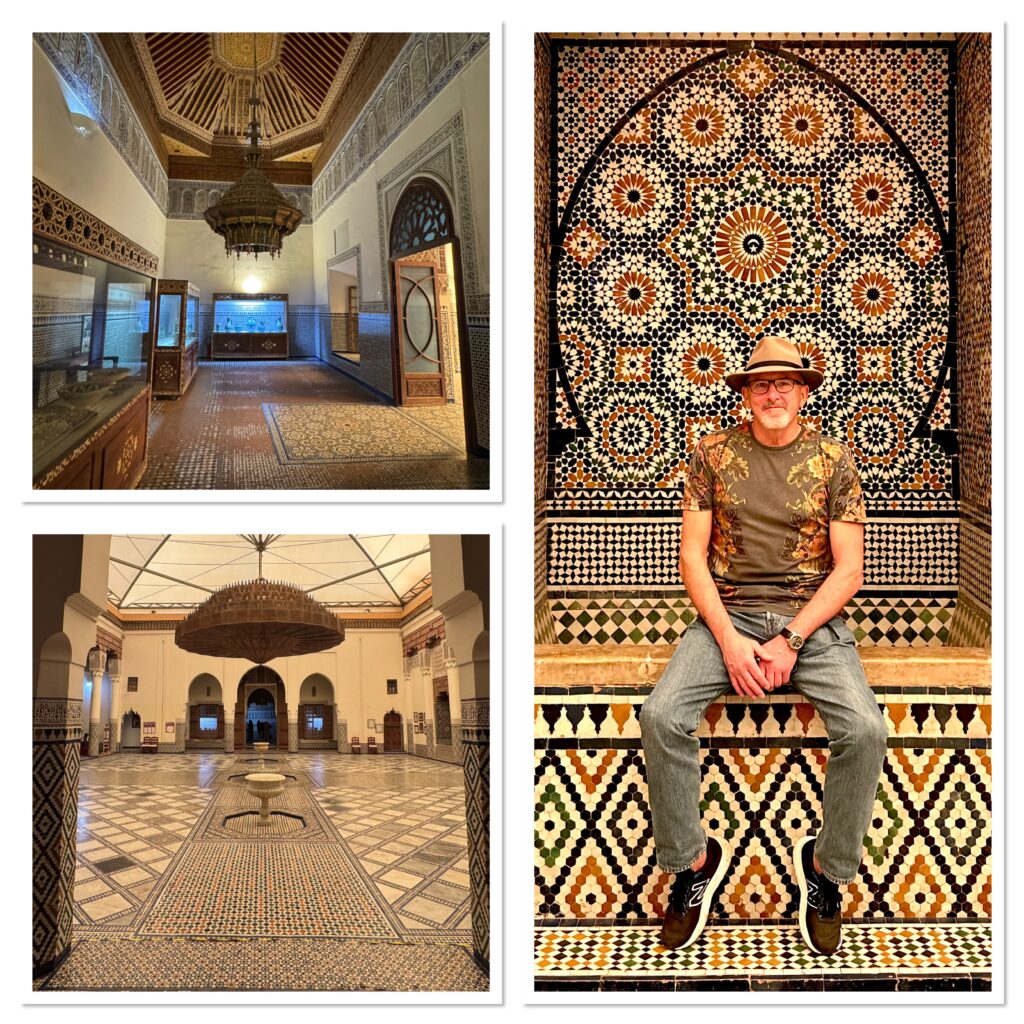
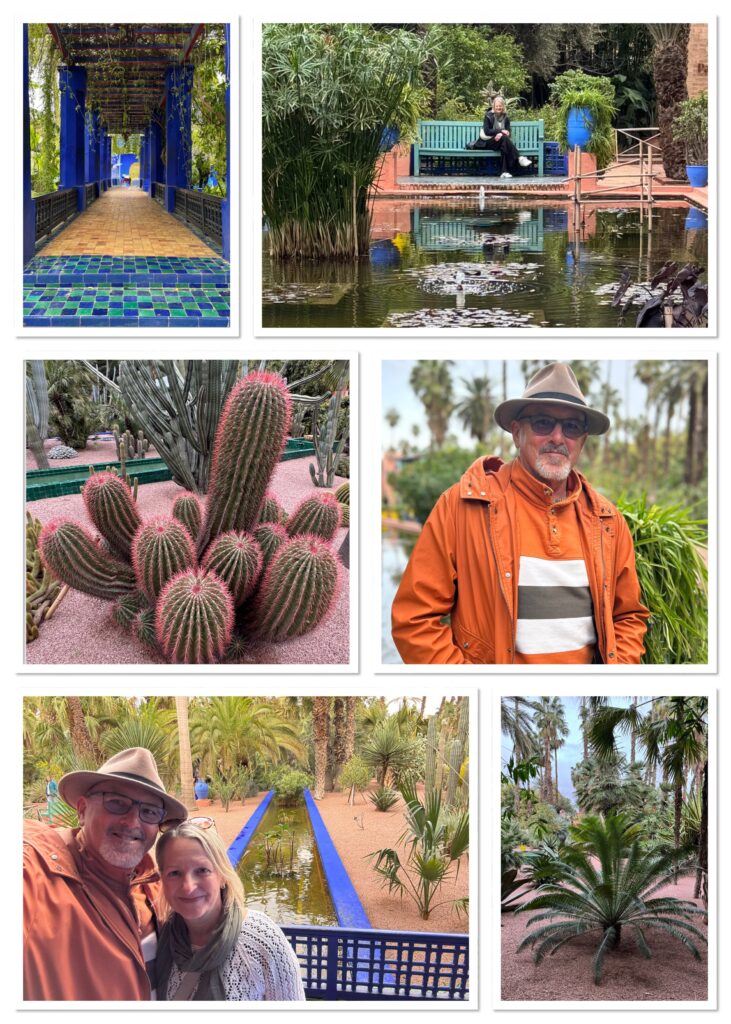
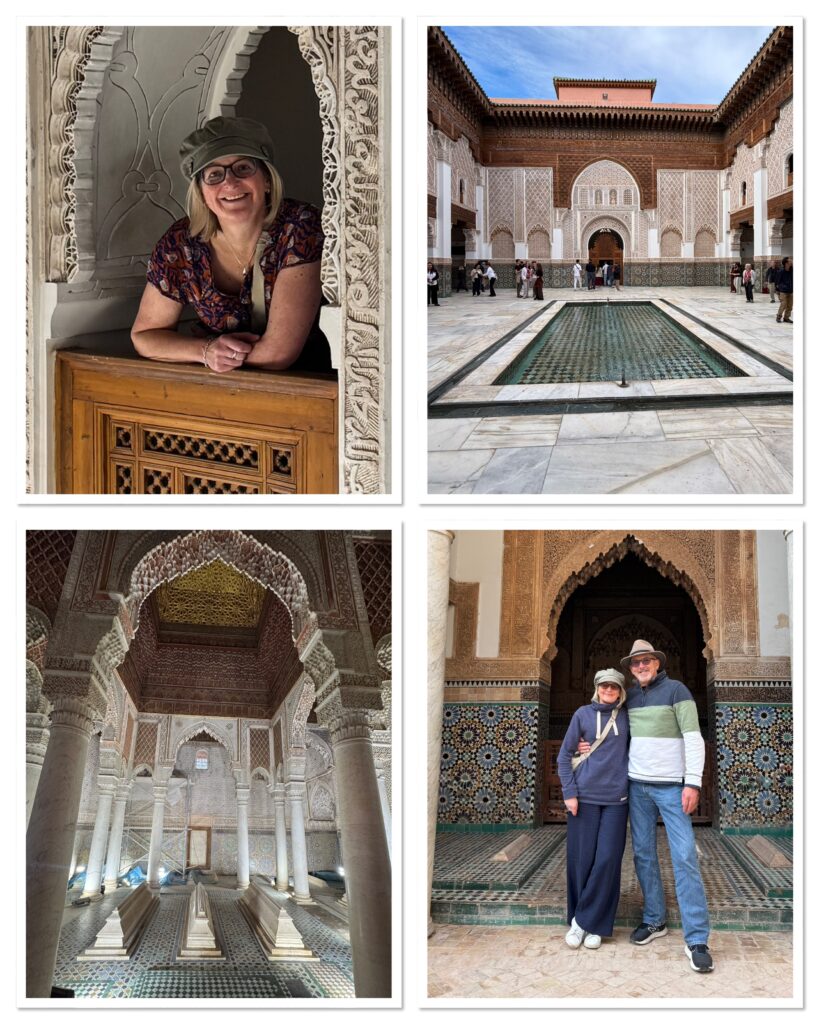
We also managed to tick off several sights we’d missed previously: the Marrakesh Museum, Saadian Tombs, Madrasa Ben Youssef, and the Yves Saint Laurent Gardens, all stunning.
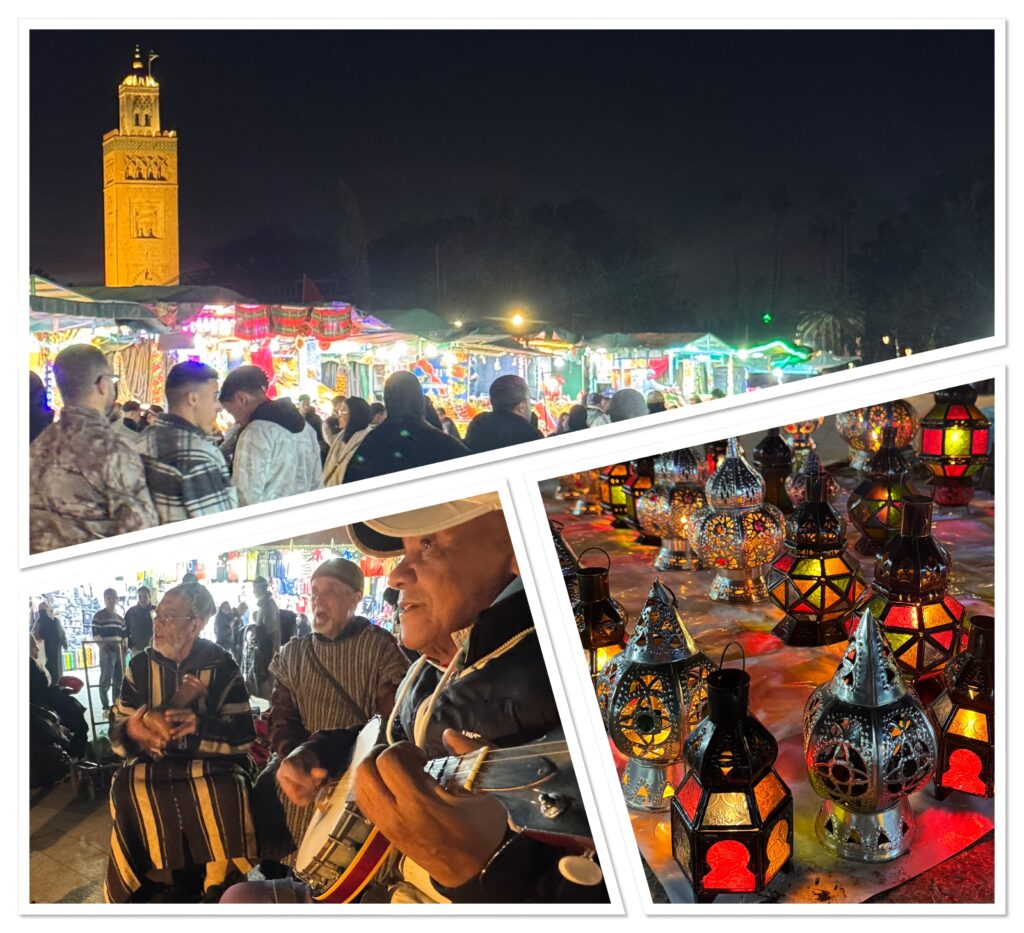
The main souk at Jemaa El Fnaa was buzzing as ever. Still, we carefully avoided some of the street entertainment involving cobras and monkeys!
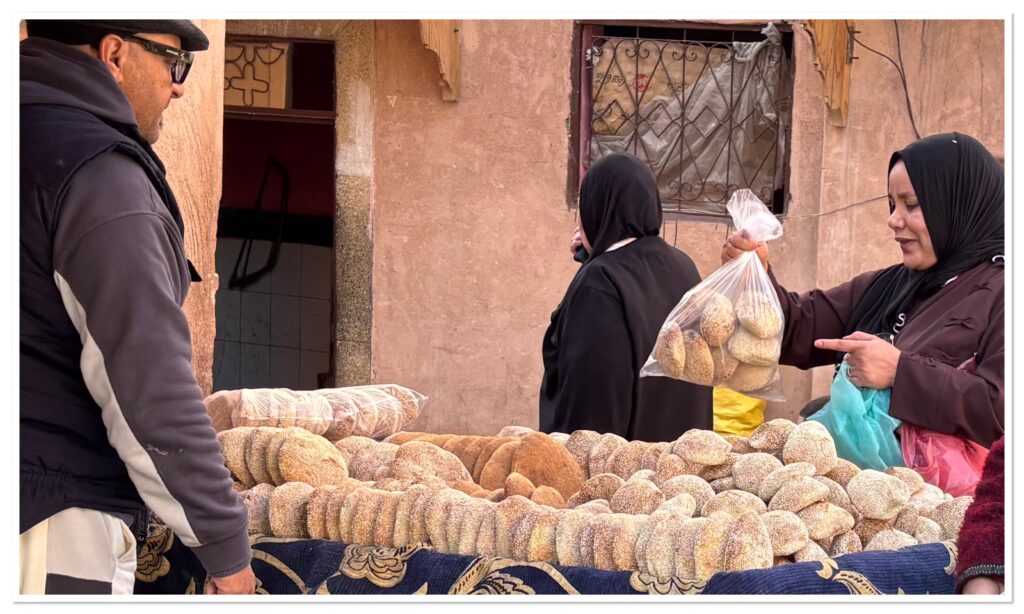
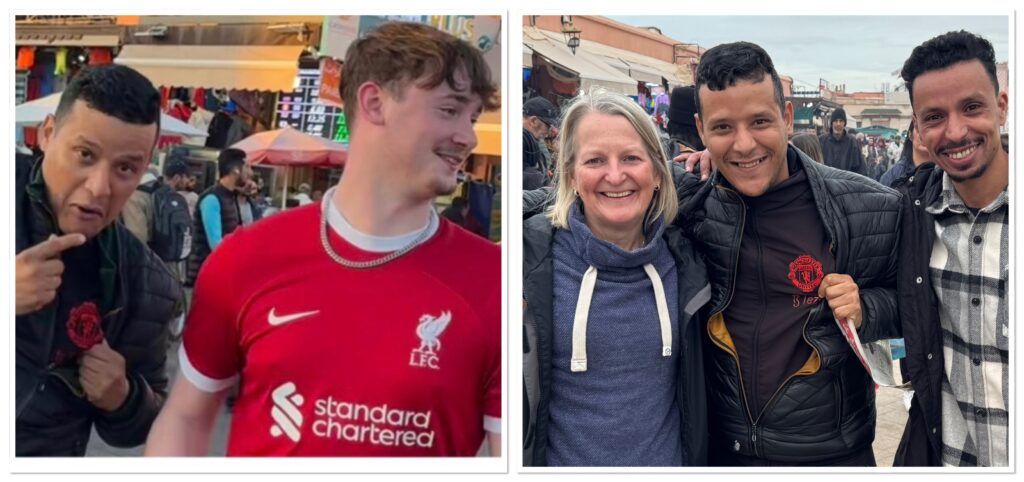
We bumped into Abdul again, a food stall-holder I last met a year ago when I came here with Natty (picture from that trip below). Once again he was proudly wearing his Manchester United shirt, but being a Manc and distant MU fan, Emma didn’t run away unlike that plastic Scouse son of mine 😂.
So, all in all, another wonderful week in Morocco. I can’t fault the place, except perhaps for recycling and rubbish control. Then again, maybe that’s something we all need to do better.
Hints and Tips
Flights – the usual good deal with WizzAir
Transport – Marakesh to Essaouira Tourist bus, Supratours. Only 100DH (£7.90) each way for a 3.5hr coach trip in pretty good comfort. Any bag over hand luggage size needs to be stored for an additional 12DH (£1). The bus stops half way for refreshments and toilet stop. I bought tickets via 12go
Public Transport – around Essaouira, Limabus. They have 9 routes, most of which depart from the bus stops just on the other side of the north gate from the Medina (Bab Doukkala). You can’t buy tickets in advance, but routes can be found at limabusessaouira.com
————————-
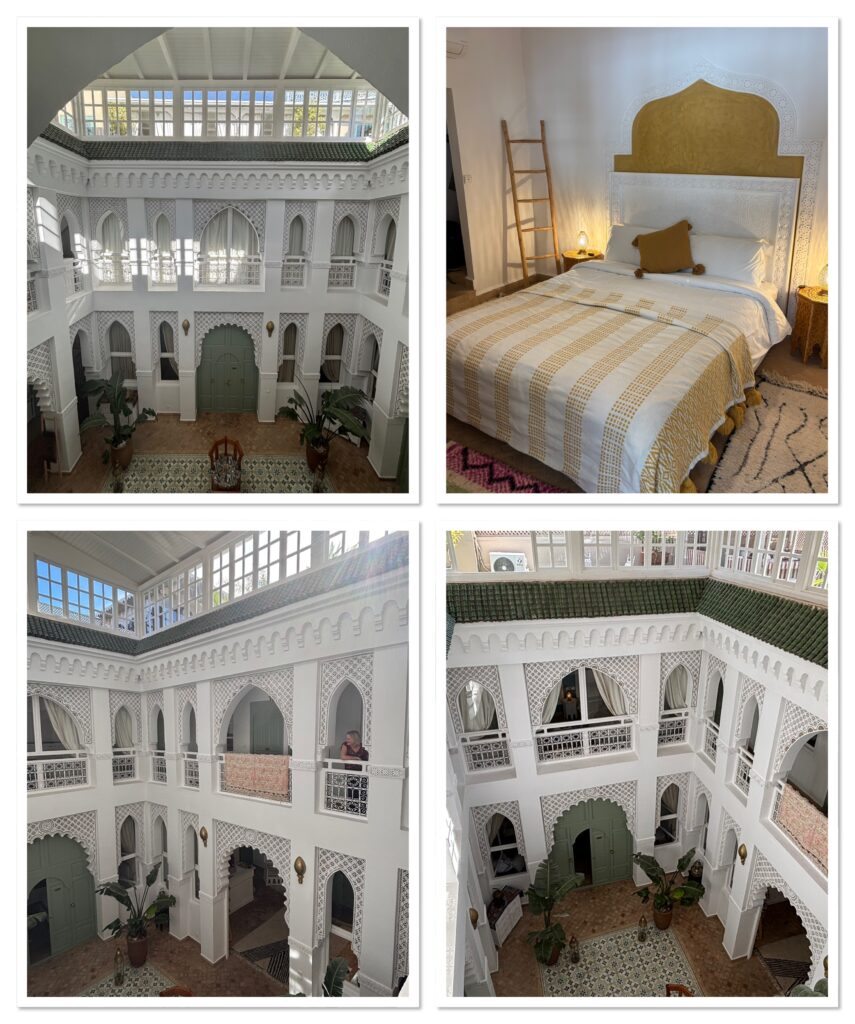
Accommodation 1 : Marrakesh – Roid Zeitoun Palace. 120 Derb Sidi Moussa, Riad Zitoune Jdid, Marrakesh 40040. This is 9.6 on Booking.com, we stayed for one night and loved it. Quite central and easy to find. We would go again and paid £36pppn incl. breakfast.

——————————
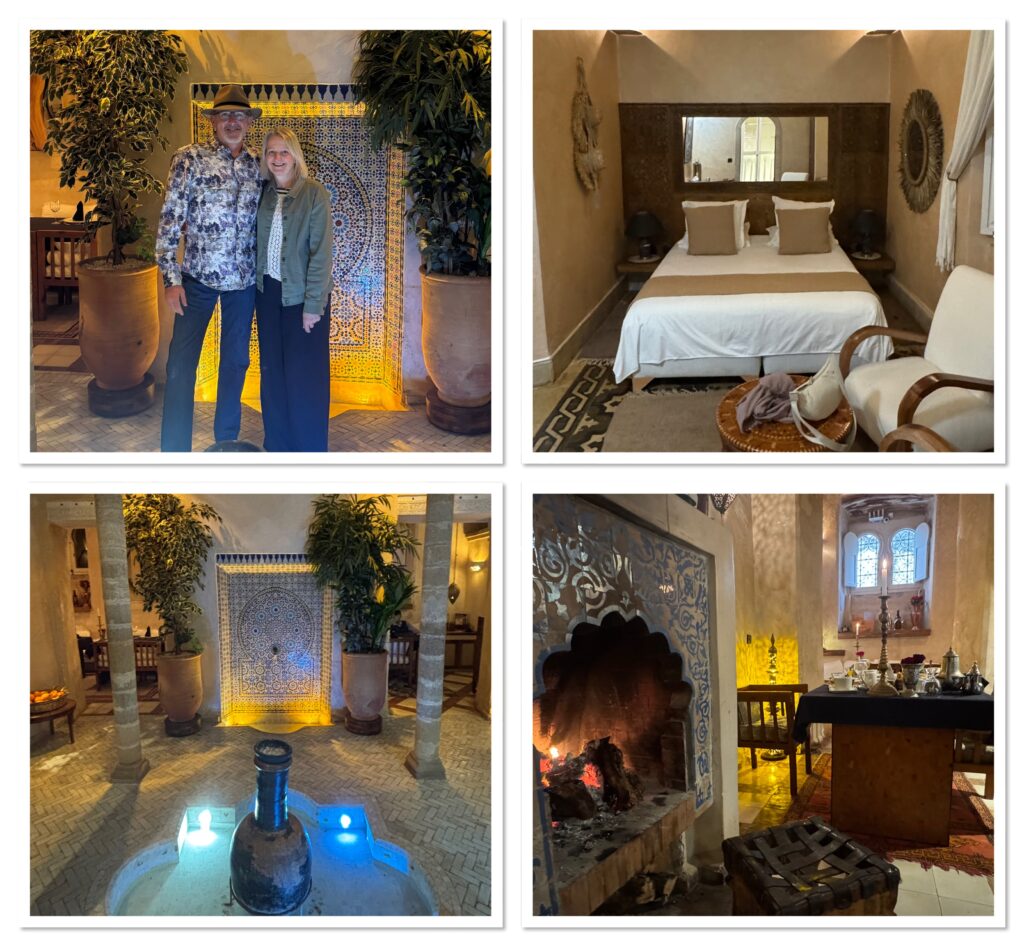
Accommodation 2: Essaouira – Riad Malaïka, 17 Rue Zayan, Essaouira 44100. This is again 9.6 on Booking.com and was very comfortable, with amazing service. Central too. We stayed two nights. It was the most pricey of the trip, but worth it given the quality. We paid £48pppn, incl. breakfast, the most upmarket place we stayed in.
—————————-
Accommodation 3: Essaouira, Chems Bleu, Moulay Azouz, 14 Essaouira 44000. This one had the best views and was perched on the top of the city walls. It was an amazing price around £25 per person per night (including breakfast). It’s also 9.5 on Booking.com
—————————
Accommodation 4 – Marrakesh, Riad Dama & Spa, No 1 Arset Ei Houma, El Bomba Marrakesh.
I for one would come back here, firstly because of the price, not only was it only £24 per person including breakfast, it also has excellent service.
However, it was a little way outside the central Medina area, in a part of the city that looks a little run-down. So if it is your first visit here may not be ideal for a first impression. The internal decoration is also a little run down and not as cared for as other places we’ve been to, but for the price you can’t complain!
